Deck cost in Utah: composite vs wood in freeze-thaw country
Along the Wasatch Front, a professionally built pressure-treated wood deck runs roughly $30–$50 per square foot installed, and mid-grade composite runs roughly $45–$70. Those are honest ballpark planning numbers, not quotes — and the cheaper material up front is usually the more expensive one by year ten.
What does a new deck cost in Utah right now?
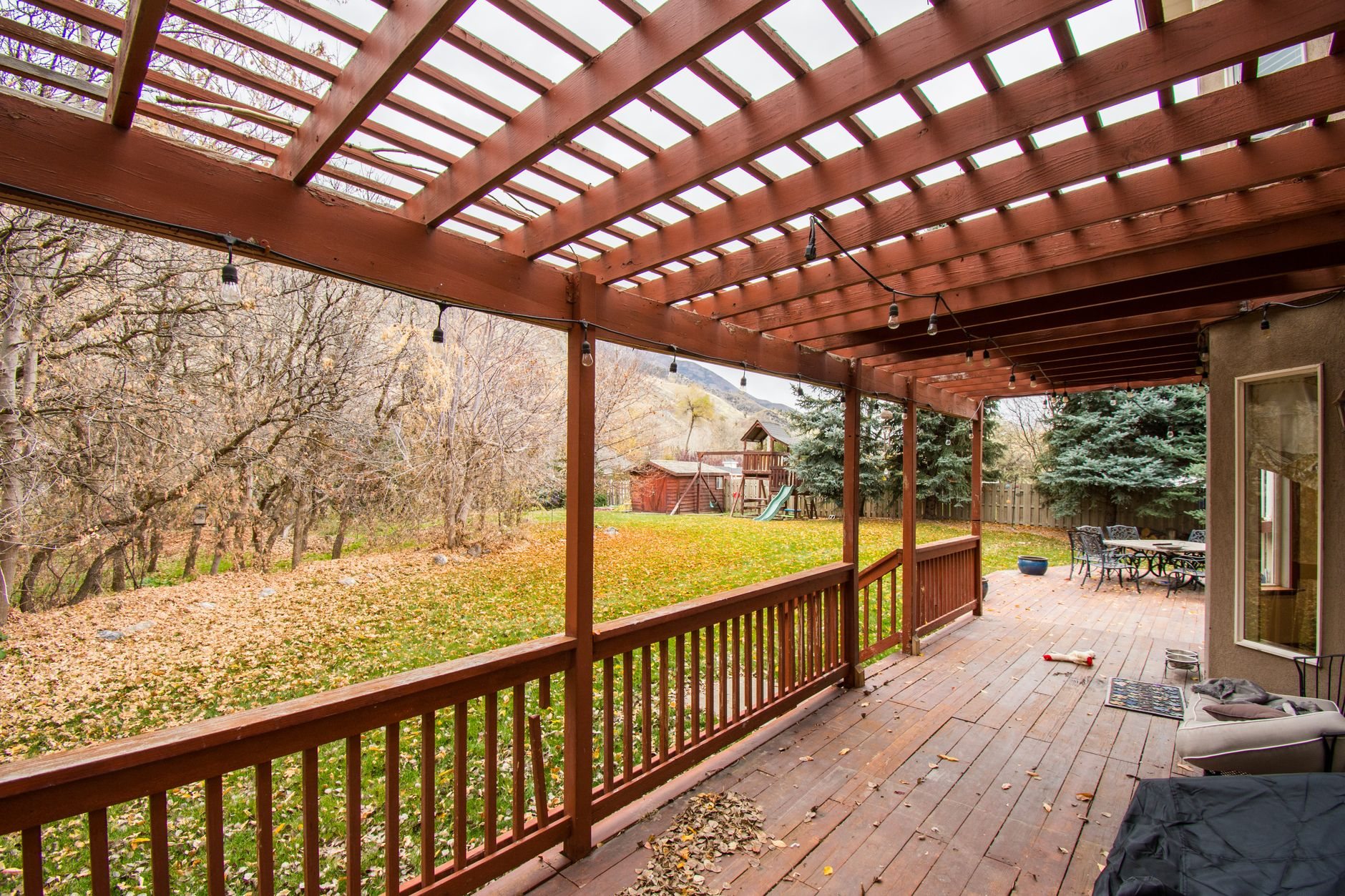
For a typical 300–400 square foot attached deck in Utah County or Salt Lake County, plan on roughly $10,000–$18,000 for pressure-treated wood and $15,000–$28,000 for composite, installed, in mid-2026. Height, railing choice, stairs, and soil conditions move those numbers more than the decking boards do. Everything below is a ballpark planning range — the real number comes from a site visit and a written estimate.
Here is the short version by material. Figures are installed costs per square foot of deck surface, including framing, footings, and basic railing on a straightforward site:
| Material | Installed cost per sq ft (Utah ballpark) | Typical maintenance | Realistic service life |
|---|---|---|---|
| Pressure-treated pine | $30–$50 | Stain/seal every 2–3 years | 15–20 years |
| Cedar | $40–$60 | Stain/seal every 2–3 years | 15–20 years |
| Mid-grade composite | $45–$70 | Wash annually | 25–30 years (warranted) |
| Premium composite / PVC | $60–$90 | Wash annually | 30–50 years (warranted) |
Ballpark planning figures for the Wasatch Front, mid-2026. Complex framing, tall walkouts, and premium railing push past these ranges.
How much does a composite deck cost per square foot in Utah?
Mid-grade composite decking lands around $45–$70 per square foot installed here; premium capped composite and PVC run $60–$90. Boards alone are only part of it — composite decks ride on the same pressure-treated frame as wood decks, so framing, footings, and labor make up most of the bill either way.
What you’re buying with composite is the cap: a bonded polymer shell that shrugs off the two things Utah is hardest on — high-elevation UV and repeated freeze-thaw. At 4,500 feet and up, sun exposure fades and checks wood finishes noticeably faster than at sea level. Manufacturers publish their own comparisons — Trex’s wood-vs-composite data puts wood maintenance at several hundred dollars a year against near-zero for capped boards, and while that’s a manufacturer talking, our field experience along the bench supports the direction if not always the exact figure. We walk through board lines and colors on our composite deck page.
How much does a wood deck cost per square foot in Utah?
Pressure-treated pine runs roughly $30–$50 per square foot installed; cedar runs $40–$60. Wood is the cheaper ticket into a deck, it takes stain in whatever color you want, and a well-built pressure-treated deck is a legitimately good structure — most of the decks in Utah are exactly that.
The honest caveat is the maintenance clock. Wasatch Front weather delivers 100+ freeze-thaw days a year: moisture gets into board surfaces and fastener penetrations, freezes, expands, and slowly opens checks and cups boards. Combine that with summer UV and a finish that would last four years in a milder climate lasts two to three here. Budget $400–$900 per professional stain-and-seal cycle on a 300 square foot deck, every two to three years, for the life of the structure.
Which is cheaper over 15 years, composite or wood?
Run the math on a 300 square foot deck and composite usually wins by year eight to ten in Utah. Wood at $40 per square foot costs about $12,000 up front; add six stain cycles over 15 years at $400–$900 each and you’re at $14,500–$17,500, plus a handful of board and fastener replacements. Composite at $55 per square foot costs about $16,500 up front and roughly nothing after that beyond a spring wash.
That crossover comes sooner here than the national figures suggest, because our UV and freeze-thaw cycle compress the re-staining interval. The counterargument is real too: if you’re selling within five years, or you genuinely enjoy the ritual and look of freshly oiled cedar, wood is the rational pick. We’ll tell you which side of that line your situation falls on — the answer isn’t always composite.
What moves the price beyond the decking boards?
Five factors swing a Utah deck bid more than the wood-vs-composite decision, and footings top the list. Along the Wasatch Front, footings must reach frost depth — commonly 30 inches, deeper in some jurisdictions — and bench lots with expansive clay or collapsible soils sometimes need engineered footings beyond the standard detail.
- Footings and soil. Frost-depth concrete piers run a few hundred dollars each on good ground. Collapsible bench soils or steep lots can require larger or engineered footings — the single biggest hidden variable.
- Height. A walkout-basement deck ten feet off grade needs taller posts, bracing, longer stairs and code railing — often 30–50% more than the same footprint at grade.
- Railing. The quiet budget-eater. Wood railing runs roughly $50–$80 per linear foot installed; composite $80–$130; steel cable or aluminum $130–$250. A wraparound deck can carry more dollars in railing than in decking.
- Snow load. Wasatch Front decks are designed for ground snow loads around 40 psf on the valley floor and higher on bench and canyon lots — that sizes beams, joists, and hardware, and it’s not a place to economize.
- Ledger and flashing. Attaching to the house correctly — flashed, lagged into structure, not just the rim sheathing — costs little extra when done right and thousands when done wrong.
Do you need a permit for a deck in Utah?
Almost always, yes. Most Utah cities require a permit for any deck attached to the house or standing 30 inches or more above grade; small freestanding ground-level decks are often exempt. Requirements and handouts vary by city — Herriman’s deck page is a good example of what jurisdictions ask for — so verify with your city’s building department before digging. Permits for a straightforward residential deck typically run a few hundred dollars, and we handle the drawings, submission, and inspections as part of every deck construction project.
When should you call a contractor instead of building it yourself?
A ground-level floating deck under 200 square feet is a fair weekend-warrior project — no frost footings, often no permit. Call a licensed contractor when the deck attaches to the house, stands more than 30 inches off grade, sits on a slope or questionable soil, or carries a roof or pergola above it. Those are the versions where footing depth, ledger flashing, and railing code stop being details and start being the whole job.
Grandview builds decks across Utah County and Salt Lake County under a Utah B100 general contractor license, from simple pressure-treated platforms to multi-level composite builds with integrated site and structure work. If you already have a design, we’ll price it straight. If you don’t, we’ll start with what the site allows and what the budget should buy. We are fond of straight lines and straight answers.
Get a real number for your deck
Send us your rough dimensions and a photo of the site, and we’ll give you a straight read on material, budget range, and permit path — usually within a couple of hours during business hours.