
Deck Stairs & Railings in Utah County
Deck stairs and railings carry the people, get inspected hardest, and fail first when built as an afterthought. Grandview builds stair runs and installs wood, aluminum, steel, cable, and glass railing on new and existing decks across Utah County, under a B100 general contractor license.
When stairs and railings are the project, not the deck
Stairs and guards usually arrive as line items in a full deck construction project or a second-story deck build. This page is for the other cases: a guard that wobbles when you lean on it, a stair run pulling away from the frame, a walkout with no stairs to the yard, or a swap from 2×2 pickets to cable or glass so a Wasatch view stops being fenced off.
If the framing underneath is also failing, start with deck repair — posts bolted to a rotten rim joist are anchored to nothing. Tiers and transitions belong in a multi-level deck design; where stairs reach grade and keep descending, outdoor steps in concrete take over.
What makes a deck stair stay level for twenty years
A deck stair is three things: stringers, a connection at the top, and a landing at the bottom. Stringers are cut from 2×12 pressure-treated stock; the uncut wood behind the notches carries the load, so we space them tight — typically 12 inches on center under composite treads, which span less than wood. Rise and run are laid out once against the finished deck and landing; code allows no more than 3/8 inch of variation between risers, and your feet notice less.
At the top, stringers hang from the rim on manufactured connectors and structural screws, never toe-nails, with the rim blocked back to the joists so the stair load can’t twist it.
The bottom is a Utah problem. A stringer resting on a paver or gravel heaves every winter — the Wasatch Front sees roughly 100-plus freeze–thaw days a year. We land stairs on a concrete pad over compacted base or on footings below frost depth, with stringer bases on metal standoffs so end grain never sits in water. On bench lots the Utah Geological Survey maps collapsible and expansive soils that move a landing while the deck above it stays put. Runs over 12 feet of rise need an intermediate landing; on tall walkouts we often add one sooner.
Railing systems that hold up at Utah’s elevation
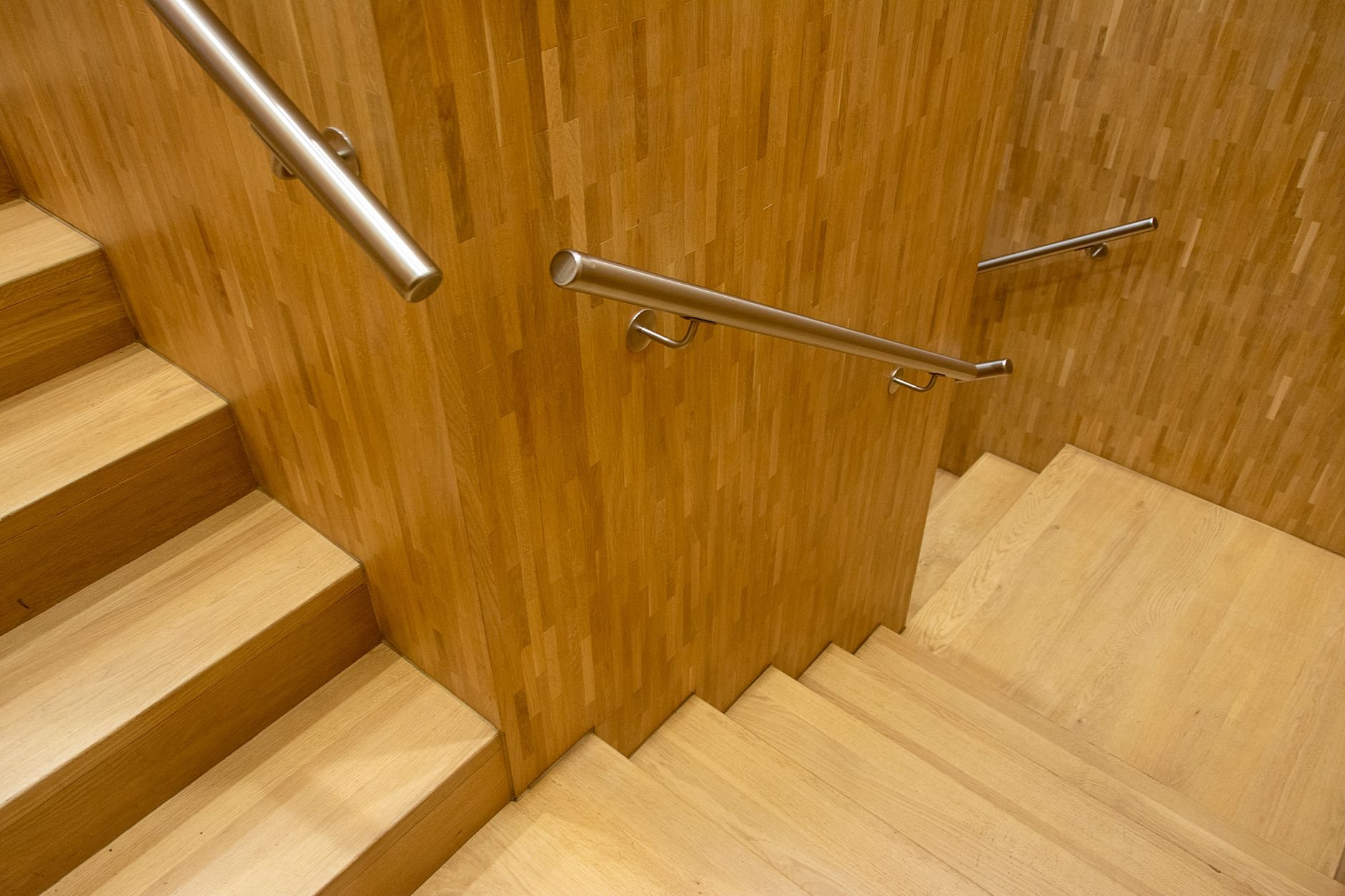
Every railing is only as good as its posts. Wood 4x4s are through-bolted to the rim with hold-down hardware, not lagged; surface-mounted metal posts bolt through blocking we add for them.
- Wood pickets. The economical baseline. UV at our elevation weathers unprotected wood fast, so plan on refinishing the rail with the deck — or pair wood posts with metal balusters.
- Aluminum. Powder-coated, light, the most common upgrade on composite decks: no rust, no refinishing. Options are on our aluminum railings page.
- Steel. Welded flat-bar or tube rail, fabricated to the deck’s actual measurements, galvanized or powder-coated. The answer for long spans, curves, and designs no catalog covers.
- Cable. Keeps the view. Needs stiffer posts at closer spacing and cables tensioned so a 4-inch sphere still can’t pass after a season of stretch. See cable railing.
- Glass. Tempered panels in metal frames: the clearest view and the heaviest wind load. On exposed lots near the canyon mouths, where Centerville-style gusts are a real design case, panel thickness and anchorage are engineered, not guessed.
Mixed systems are common — cable on the view side, wood along the house. The full range is under metal railings and handrails.
Guard and stair-rail rules, in plain terms
Under current Utah-adopted code, a deck more than 30 inches above grade needs a guard at least 36 inches tall whose openings won’t pass a 4-inch sphere. Stairs with four or more risers need a graspable handrail on at least one side, 34 to 38 inches above the nosings and continuous for the run — a 2×4 on edge doesn’t qualify; a round rail or profiled cap does. The triangle between tread, riser, and bottom rail can’t pass a 6-inch sphere. Inspectors differ on details like composite caps, so verify with your city’s building department. Every project runs under a B100 license verifiable through Utah DOPL, and we photograph post hardware and stringer connections before anything covers them.
What do deck stairs and railings cost in Utah County?
As ballpark planning numbers, not quotes: a straight run of wood deck stairs to grade with a concrete landing pad commonly lands between $2,500 and $6,000 depending on height and tread material; a turn or landing adds to that. Railing is priced per linear foot installed — roughly $40–$80 for wood pickets, $80–$150 for aluminum, $120–$250 for cable, and $200–$400 or more for glass; fabricated steel varies by design. What moves it: total rise, post count, whether the rim needs rebuilding before posts can anchor, and whether the landing is a paver or a pad. After a site walk you’ll get a budget range, then a firm estimate.
Questions we actually get
Can you replace my deck railing without replacing the deck?
Usually, yes. We check the rim joist where the new posts will anchor; if it’s sound, posts get through-bolted with fresh blocking and the old guard comes off the same day. If the rim is soft or the decking is at the end of its life, we’ll say so before you buy a railing that outlasts what it’s bolted to.
Do I need a permit just for stairs or a railing?
Often, yes. A new stair run is structural work, and a railing on a deck above 30 inches is a code-governed guard — many Utah cities want a permit and final inspection for either. Thresholds vary, so verify with your building department. We handle the application and inspections as part of the project.
Why do my deck stairs sit crooked at the bottom every spring?
Frost heave. If the stringers rest on pavers, gravel, or a thin pad poured on grade, Utah’s freeze–thaw cycles lift the landing in winter and drop it in spring, and the stair separates from the deck a little more each year. The fix is a landing on compacted base or frost-depth footings, and re-hanging the stringers on connectors.
Does cable railing meet code on a deck in Utah?
Yes, when installed correctly. Cables must stay tensioned so the 4-inch-sphere rule holds under a modest push, which means stiffer posts at closer spacing and end posts built for the pull. Cable strung loose on undersized posts is the most common railing we’re asked to redo.
Tell us what your deck needs on the way down
We reply within a couple of hours during business hours — a day at most. You’ll get a straight read on stairs, railing options, and budget before anyone commits. The rest of the family is under site, structure & envelope.