
Trim, millwork & finish carpentry in Utah County
Grandview Contractors installs baseboard, casing, crown, wainscoting, built-ins, and architectural millwork across Utah County and Salt Lake County under a Utah DOPL B100 general contractor license. Finish carpentry is the last trade on a job and the first thing anyone sees — we scope it, price it, and install it with that in mind.
Who hires a finish carpenter — and when
Most of our trim work falls into three buckets. The first is the builder-grade upgrade: a home in Lehi, Saratoga Springs, or Eagle Mountain built in the last decade with 2¼-inch baseboard, hollow-core doors cased in the thinnest profile the builder could buy, and not a stick of molding above eye level. Swapping trim is the highest-visibility change you can make to a house without moving a wall.
The second is character work — wainscoting in a dining room, a coffered ceiling over a great room, a mantel that makes the fireplace the point of the room. This is design-forward carpentry, and layout matters as much as cutting: panels should land evenly at corners, and a beam grid should center on the room, not the light fixture that happened to be there.
The third is the finish stage of a larger remodel. If we’re already running your renovation, trim is sequenced after drywall and paint priming and before final coats — one schedule, one accountable contract. If another contractor left the trim undone or done badly, we take that call too.
Running trim: baseboard to ceiling line
Linear trim is priced by the foot and judged at the joints. Every profile below gets coped inside corners, scribed fits, and nail holes you won’t find after paint.
Baseboard & casing
The workhorse upgrade. Taller baseboard and consistent, squared casing change a room more than most furniture does.
ExploreCrown molding
Ceiling molding scaled to the room, with coped corners that stay tight through Utah’s dry-winter wood movement.
ExploreWindow & door trim
Casings, sills, and aprons that make every opening look deliberate instead of production-line.
ExploreChair rail & picture rail
Classic wall-protecting and picture-hanging rails, set at heights that suit the room rather than a rulebook.
ExploreStair trim & skirtboards
Skirtboards and stair moldings — the hardest scribing in the house, where every angle is slightly different.
ExploreWainscoting & board-and-batten
Panel walls from simple batten grids to raised-panel wainscot, laid out to land evenly at corners and openings.
ExploreBuilt-in millwork: ceilings, storage, and feature walls
These are the pieces built to your walls, not bought to almost fit them — designed on paper first, then built square even when the room isn’t.
Coffered & tray ceilings
Beam grids and recessed trays that give a flat ceiling real depth, framed level and trimmed square.
ExploreCustom built-ins & shelving
Bookcases, media walls, window seats, and office storage that use every inch the wall offers.
ExploreCustom closet systems
Reach-ins to full walk-in fit-outs, designed around what you actually store rather than a catalog module.
ExploreMantels & surrounds
Mantels, legs, and surrounds sized to the firebox and built to the combustible-clearance rules that apply to it.
ExploreWood accent & slat walls
Slat and wood feature walls with even reveals, hidden fastening, and clean terminations at outlets and corners.
ExploreFaux beams & beam wraps
Hollow beams and wraps over structural steel or LVLs — the visual weight of timber without the structural load.
ExploreMaterials and method: where trim jobs are won
Utah is high desert, and interior humidity along the Wasatch Front swings hard between a swamp-cooled July and a furnace-dried January. Wood moves with it. That’s why material choice is the first real decision: paint-grade MDF is dimensionally stable and takes a finish beautifully; stain-grade hardwood — oak, maple, alder — brings the grain but demands acclimation on site before a single cut. We stage stain-grade stock in the rooms where it will live so it moves before installation, not after.
- Walk-through and scope. We measure, count openings, flag out-of-square walls and floors, and write a scope you can compare line by line.
- Profile and material selection. Samples in hand, in your light — profile scale, paint-grade versus stain-grade, and how new trim meets what stays.
- Layout before cutting. Panel walls, coffers, and slat walls get a drawn layout so seams and reveals land where they should.
- Installation. Coped corners, scribed fits, glued joints where they belong, fasteners set for filling. We are fond of straight lines and straight answers.
- Finish handoff. Caulk, fill, and sand, then a clean handoff to interior painting — or your painter, with everything prepped.
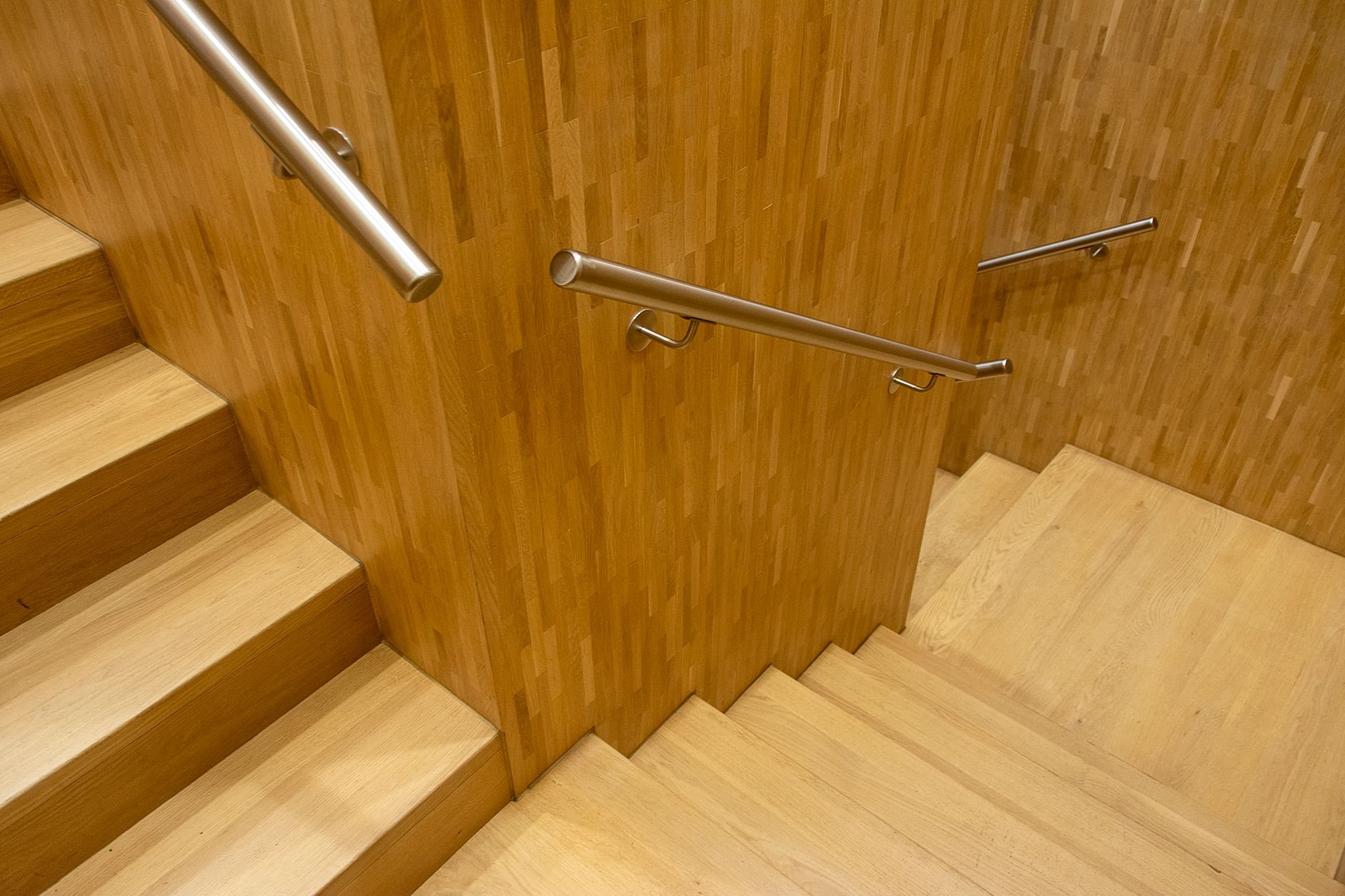
Two more things worth knowing. Stair work isn’t purely cosmetic — handrail height, graspability, and guard spacing are set by current Utah-adopted code, and we build stair trim so the railing work it meets can pass inspection. And when a built-in media wall needs outlets or low-voltage runs moved, Grandview holds the contract and manages licensed electricians; we coordinate, sequence, and quality-check their work within your project.
What finish carpentry costs in Utah
Running trim is priced by the linear foot; millwork is priced more like furniture. As a planning ballpark — not a quote — paint-grade baseboard replacement in Utah County typically runs in the $5–$12 per linear foot range installed, with material profile and demo of the old trim moving it inside that band. Stain-grade hardwood can roughly double material cost and adds finishing labor.
The other levers are geometry and height. A room with eight clean corners is quick; a stairwell, a vaulted ceiling, or a 1920s Provo bungalow where nothing is square is not. Built-ins, coffered ceilings, and paneled walls are scoped individually, and we’ll give you a defined budget range at consultation before it becomes an estimate and then a fixed proposal. Our B100 license is verifiable at dopl.utah.gov, which is a better trust signal than anything we could write here.
Questions we actually get
Do I need a permit for trim or built-in work?
Almost never for trim itself — baseboard, casing, crown, and paneling are cosmetic in the code’s eyes. Permits enter the picture when the work touches other systems: new outlets in a media wall, structural changes behind a beam wrap, or fireplace surrounds near clearance limits. We flag those dependencies in the scope, and we’ll verify anything city-specific with your building department.
Should I choose paint-grade or stain-grade trim?
Paint-grade MDF is more stable, more affordable, and finishes to a perfectly smooth line — the right answer for most whole-home trim packages. Stain-grade hardwood earns its premium where grain is the point: mantels, built-ins, stair parts, and feature walls. Many projects mix both, and we’ll show you samples in your own light before you decide.
What drives the cost of a trim package up or down?
Linear footage, material grade, and geometry. Paint-grade costs less than stain-grade; a squared-off newer home installs faster than an older one where every wall needs scribing; and tall ceilings, stairwells, and vaults add ladder-and-layout time. Demo of existing trim and the paint handoff are the line items people forget — we price both up front.
Why did the miters on my old trim open up in winter?
Utah’s furnace-dried winter air shrinks wood across its width, and a miter opens at exactly that angle. It’s usually a symptom of unacclimated stock, unglued joints, or both. We acclimate stain-grade material on site, glue miters rather than relying on caulk, and cope inside corners so seasonal movement stays invisible.
Related services
Trim rarely travels alone. New baseboard usually follows new floors from our flooring team, and a trim package lands best when cabinetry and countertops are designed to the same profiles. If walls need patching or texture work before paneling goes up, our drywall crew handles that in the same schedule.
Tell us what you’re working on
We reply within a couple of hours during business hours — a day at most. You’ll get a straight read on scope, sequence, and budget before anyone commits to anything.