
Crown Molding Installation in Utah County
Crown molding is the angled trim that bridges the wall-to-ceiling joint, and it belongs in any room where that line looks unfinished, textured, or builder-grade. Grandview Contractors installs single-piece and built-up crown across Utah County and Salt Lake County under a Utah DOPL B100 general contractor license, with coped corners and backer blocking so it stays tight through a Utah winter.
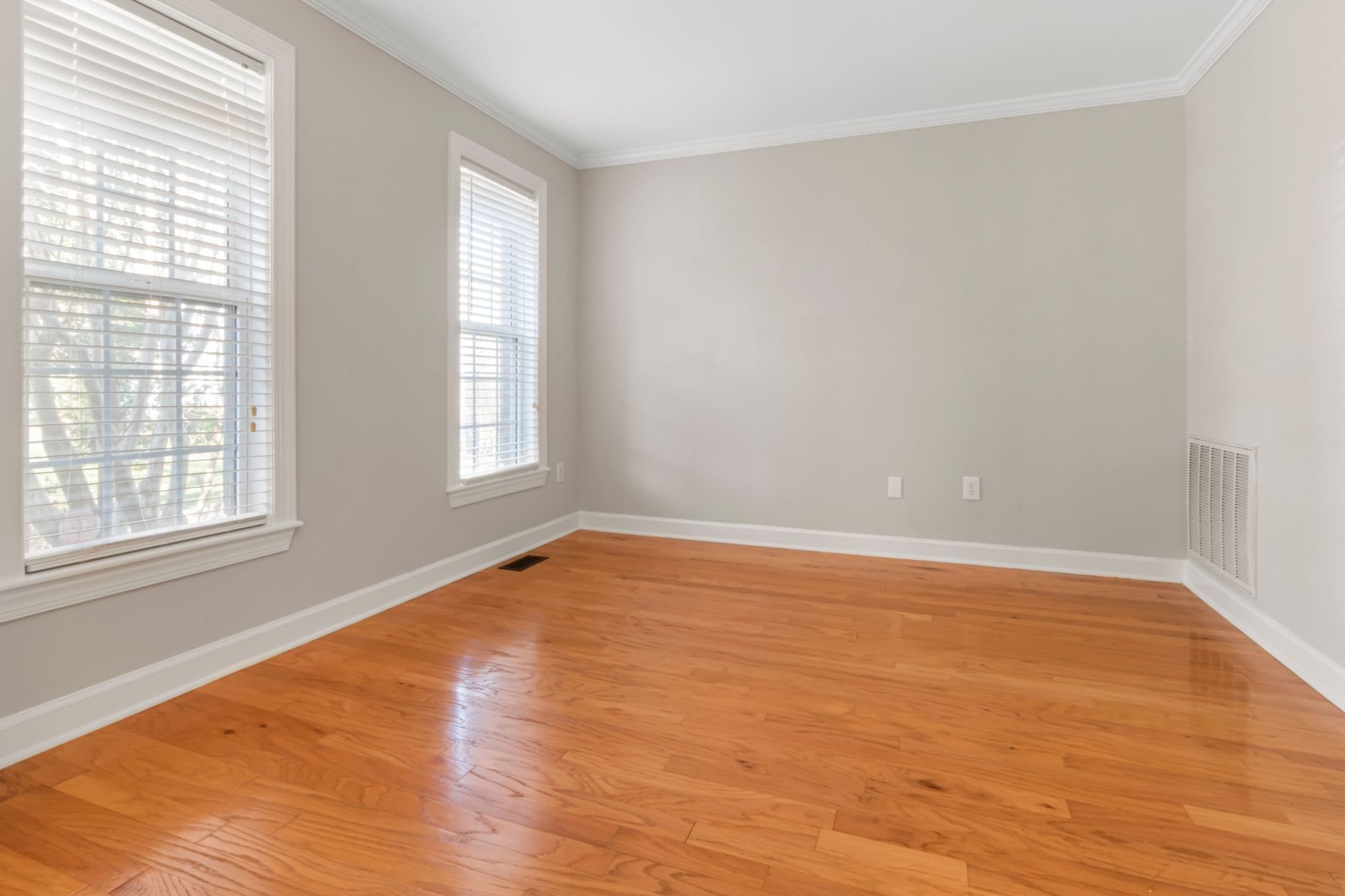
When crown molding is the right choice — and when a sibling is
Crown is the ceiling-line piece of a trim and millwork package. It stands alone in a dining room or entry, or tops off a whole-house upgrade that starts with taller baseboard and squared casing. The typical client has a Lehi, Saratoga Springs, or Eagle Mountain home with nine-foot ceilings, a knockdown texture that stops an inch short of the wall, and nothing above the door heads.
It is not the answer to every ceiling. Depth across the whole plane is a coffered or tray ceiling. A horizontal line lower on the wall is picture rail or chair rail. And a vaulted great room is often better served by faux beams than by crown running up a rake, which rarely looks right on a steep pitch.
Choosing crown size, spring angle, and material
Crown is sized to ceiling height, not to taste alone. An eight-foot ceiling carries a 3- to 4½-inch profile; nine-foot rooms take 4½ to 6 inches; at ten feet and up, a built-up assembly earns its keep, stacking crown on a flat frieze board or bed molding so it reads as one large profile without the cost of a single wide stick. Wasatch Front production homes often pair nine-foot main floors with eight-foot basements, so one house may get two sizes.
Spring angle is the detail most homeowners never hear about. Stock crown comes in 38/52 and 45/45 profiles, the angle it leans off the wall. Mixing them on one run produces corners that never close, so we read existing crown with a bevel gauge before ordering.
Material follows the finish. Paint-grade MDF is stable, affordable, and sprays beautifully, but it is heavy on long runs and dislikes damp bathrooms. Finger-jointed pine is lighter and holds a nail better in built-up stacks. Flexible polyurethane crown handles curved walls and bay windows. Stain-grade alder, oak, or maple is the choice when grain is the point, often over built-ins or kitchen cabinets, and it gets a week in the room before the first cut.
How we install crown molding
- Measure the room, not the drawing. Every corner checked for square, every wall for bow, and the ceiling for the dips a texture hides.
- Snap the layout line. A given size and spring angle has a fixed drop from the ceiling. We run that line level around the room, even where the ceiling is not.
- Install backer blocking. Crown is hollow behind, and ceiling joists often run the wrong way. Triangular backer strips on the top plate give every nail wood to bite. Skipping this is why crown pulls off a ceiling a year later.
- Cope inside corners, miter outside ones. Coped joints follow the profile and stay closed as wood moves. Outside corners are glued and pinned. Long runs get a scarf joint over blocking, never a butt joint in open air.
- Return the ends. Where crown dies into a stair wall, a cabinet, or a ceiling-height change, a mitered return wraps the profile back to the wall instead of a flat sawn end.
- Fill, caulk, and hand off. Nail holes filled, both edges caulked to the texture, then a clean handoff to interior painting or your painter.
Wasatch Front interior air dries out hard once furnaces run in November, and a miter that was tight in August can open an eighth of an inch by February; coping, glue, and acclimated stock are the defense, caulk alone is not. And cabinet crown in a settled 1970s Orem split-level usually meets a ceiling more out of level than trim can hide, so we plan a scribed filler or shadow reveal rather than pretending the gap is not there. Problems happen. Surprises should not.

What does crown molding installation cost in Utah County?
As a planning ballpark, not a quote: single-piece paint-grade crown installed in Utah County typically falls in the $8–$16 per linear foot range, including material, blocking, and filling. Built-up two- or three-piece crown runs roughly $15–$30 per foot. Stain-grade hardwood adds material and finishing labor on top.
What moves the number: corner count, ceiling height above nine feet, vaulted or stepped ceilings, and how much ceiling texture has to be flattened at the joint. You get a budget range at consultation, then an estimate and a fixed proposal. Our B100 license is verifiable at dopl.utah.gov.
Questions we actually get
Can crown molding go on a vaulted or sloped ceiling?
Yes, but it takes compound transition cuts where the flat wall meets the rake, and on steep pitches the profile distorts enough that most people prefer a flat frieze board or faux beams instead. We check the pitch before recommending crown up a vault.
Does crown molding work with a textured ceiling?
It does, and it is one of the best reasons to install it, since crown hides the ragged edge where knockdown texture stops short of the wall. The top edge gets caulked to the texture; where texture is heavy, we skim a narrow band flat first so the caulk line stays straight.
Can you match the crown already in part of my house?
Usually. We take a profile tracing and a spring-angle reading from the existing run, then source the same stock or the closest current equivalent. If the original was a discontinued profile, a built-up assembly can get within a hair of it, and once painted the difference disappears.
Should crown be installed before or after painting?
After walls are primed and before final coats. That order lets the painter caulk and spray the crown with the ceiling and wall edges in one pass, which is where a crisp line comes from. If the room is already finished, we install, fill, and caulk, and the painter touches up both edges.
Tell us what you’re working on
Send us the rooms and ceiling heights and you’ll get a straight read on profile, material, and budget within a couple of hours during business hours, a day at most. If crown is part of a larger renovation, we sequence it that way.