
Bathroom & Wet-Area Membrane Waterproofing
Shower waterproofing is the sheet or liquid-applied membrane behind the tile and under the pan that keeps the water you run on purpose out of the framing and the room below. Grandview installs and flood-tests these membranes in showers, curbless bathrooms, wet rooms, and steam showers across Utah County and Salt Lake County, under a B100 general contractor license.
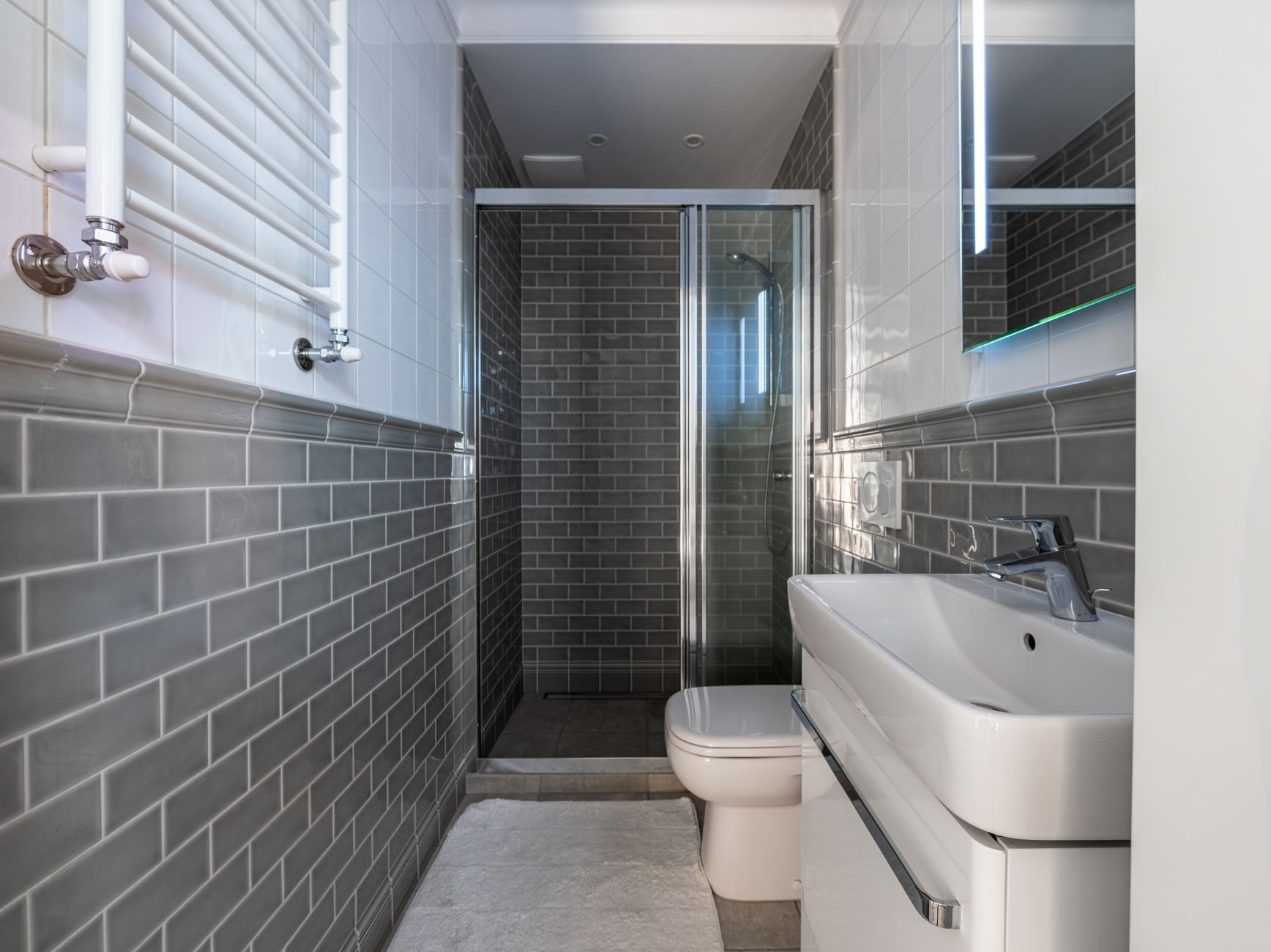
When a wet-area membrane is the right scope
Everything else in our waterproofing and drainage family, and most of the wider site, structure & envelope work, deals with water arriving from outside: snowmelt against a basement wall, a cloudburst in a window well, rain on a deck over living space. A shower is the one place where you deliberately pour forty gallons of hot water a day onto a wall. The membrane is what makes that reasonable.
This is the right scope if you’re building or rebuilding a tiled shower, converting a tub, planning a curbless or wet-room bathroom, adding a steam shower, or opening up one that’s leaking into the ceiling below. It also covers tiled tub decks, benches, and niches, which fail more often than floors do.
In a basement, the membrane is half the story. Moisture also rises through the slab, so a basement bathroom addition often pairs this work with a below-slab vapor barrier where the floor is cut for the drain. And if the wall behind the shower is damp before anyone turns a faucet, that’s an interior basement waterproofing problem to solve first.
What a membrane shower actually involves
Tile and grout are not waterproof; grout and the thinset behind it both absorb water. The Tile Council of North America handbook treats the membrane, not the tile, as the waterproofing layer, and every shower we build starts from that. Two membrane families do the job:
Bonded sheet membranes (Schluter Kerdi, Laticrete Hydro Ban Sheet, Wedi board) are polyethylene or foam sheets set into thinset over the backer. Seams overlap two inches; inside corners and the curb get preformed pieces. Their thickness is set at the factory. Liquid-applied membranes (RedGard, Hydro Ban, Mapelastic AquaDefense) go on in two coats to a specified dry-film thickness, with fabric at every change of plane, and suit curved benches and odd niches. A steam shower also gets a vapor-retarding layer on walls and ceiling, because steam goes where liquid water never would.
The pan matters more than the walls. We pre-slope the floor a quarter inch per foot, run the membrane continuously from floor to wall, and use a bonding-flange drain the membrane adheres to directly, rather than an older clamping-ring drain buried between two mud beds. For that specific system, see our Schluter shower waterproofing page or the manufacturer’s details at schluter.com.
- Substrate. Cement or foam board, screwed flat, no drywall in the wet zone. Bowed studs get shimmed first.
- Pan and drain. Pre-slope, bonding-flange drain set to finished tile height, curb or recessed linear drain for curbless layouts.
- Membrane. Sheet or liquid, continuous from the drain flange to at least 72 inches above the pan, with corners, niche, and bench seams reinforced.
- Flood test. Plug the drain, fill the pan to the curb, mark the line, wait 24 hours. Any drop and we find out why before a single tile goes on.
- Inspection, then tile. Most cities want to see the pan holding water. We schedule it, then hand a verified assembly to the tile phase.
Three Utah details that change how we build showers
Dry air cures liquid membranes fast. At 4,500 feet with single-digit winter humidity, a liquid coat can skin over in under an hour, which makes it easy to build a film that looks done and measures thin. We check wet-film thickness with a gauge, not by eye, and run the second coat perpendicular to the first.
Hard water finds the weak joint. Wasatch Front water scales grout lines within a few years, and the scrubbing and acidic cleaners that follow open those joints further. A shower that relies on sealed grout will leak eventually. A shower with a continuous membrane behind it doesn’t care what the grout is doing.
Basement bathrooms sit on radon-prone ground. Much of Utah County and Salt Lake County sits on radon-producing soils, and cutting a slab for a new shower drain opens a path for it. We seal the slab penetration when we trench, and tie into a mitigation rough-in where one exists, the same way we handle any wet-room build on a slab.
What does shower waterproofing cost in Utah?
As ballpark planning numbers, the waterproofing layer of a standard alcove shower (backer, pan, drain, membrane, flood test) typically runs $1,500 to $3,500 in Utah County and Salt Lake County. A curbless shower conversion or full wet room usually lands at $3,000 to $7,000 for the same layer, because the floor gets recessed or the whole room sloped and membraned. Tile, fixtures, and plumbing are on top.
What moves the number: footprint and wall height, linear versus center drain, benches and niches (each adds seams), a steam ceiling, and whether subfloor or framing needs repair once the old shower comes out. Rot under a failed pan is the most common surprise; you’ll hear about it the day we find it. Problems happen. Surprises should not.
Questions we actually get
Can you waterproof my existing shower without tearing out the tile?
Not properly. The membrane lives behind the tile, so a leaking shower means tile and backer come out and the assembly gets rebuilt. Sealers and regrouting buy time, not a fix. If the leak is only at a valve penetration or the curb, a partial rebuild is sometimes possible.
Sheet membrane or liquid: which should I pick?
Both work when installed to spec. Sheet systems give a known thickness and pair with their own drains, so we lean that way for standard showers and curbless pans. Liquid membranes handle curved benches and tub decks more easily. The system matters less than the seams and the flood test.
Does the inspector need to see the pan before tile?
Usually, yes. Most Utah cities inspect the pan under water before it’s covered, and current Utah-adopted code expects a lined, tested receptor. We build that inspection into the sequence so tile isn’t waiting on it. Confirm the exact requirement with your city’s building department, since Provo, Lehi, and Salt Lake City each run it a little differently.
Who does the tile after the membrane is tested?
Grandview carries the shower from framing through membrane, flood test, inspection, and tile under one contract, so there’s no handoff where responsibility for the waterproofing gets lost. If you already have a tile setter, we can deliver a tested, inspected assembly and document the flood test so everyone knows where the line is.
Tell us what you’re working on
We reply within a couple of hours during business hours, a day at most. You’ll get a straight read on scope, sequence, and budget before anyone commits to anything.