
Home Theater & AV Wiring
Home theater and AV wiring is the in-wall speaker cable, subwoofer runs, HDMI conduit, control wiring, and rack power roughed into a media room before the drywall closes it up. It’s the right scope for a basement theater, a great-room surround system, or a bonus-room build-out in Utah County; Grandview holds the contract under a B100 general contractor license and manages the licensed low-voltage and electrical trade partners who pull, terminate, and test it.
When theater wiring is the scope, and when a sibling page fits better
This page is about one room: getting sound to seven or eleven speaker locations, video from a rack to a screen, and control signals to everything in between. If the question is Cat6 to every room and a central enclosure, that’s structured wiring and data cabling, and a theater room usually sits on top of it. If the goal is lighting scenes, motorized shades, and one remote that runs the house, that’s smart home automation. Streaming boxes that buffer are a network and Wi-Fi problem, not a speaker-wire problem. If the room still needs framing, insulation, and a ceiling, the wiring runs inside a basement home theater build.
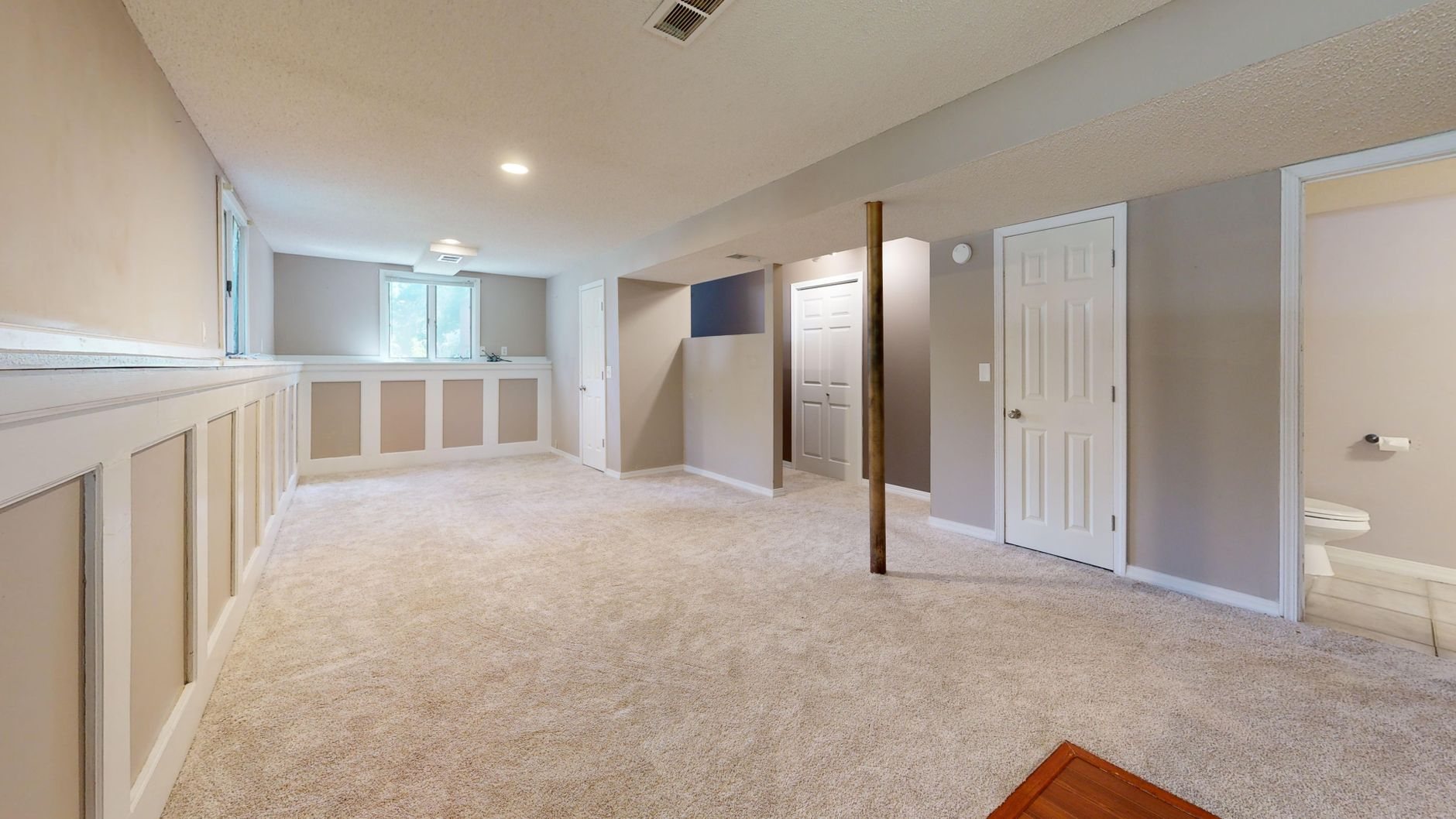
Most theater rooms in Utah County end up in the basement, because most homes here have one: full-depth, poured-wall basements are standard in the subdivisions around Lehi, Saratoga Springs, and Eagle Mountain, and in the older ramblers of Provo and Orem. Open joist bays, an unfinished mechanical room for the rack, and concrete that keeps equipment cool make it the easiest room in the house to wire correctly, as long as the cable goes in before the ceiling does. Retrofits into a finished family room are possible; the budget just moves from cable to access.
How a theater pre-wire is specified and sequenced
- Speaker layout on the plan. Seating, screen wall, and speaker count get fixed before rough-in: 5.1 for a family room, 7.1 or 7.2.4 Atmos for a dedicated theater, with the four height channels marked on the ceiling plan. Each location gets a low-voltage bracket, so the plate lands where the speaker actually goes.
- Cable sized to the run. In-wall speaker wire has to be CL2 or CL3 rated. 16 AWG covers runs under about 50 feet; 14 AWG for anything longer, which the rear and height channels in a wide basement room often are. Subwoofer locations get RG6 coax plus a power outlet, and we pull two sub runs even if one sub is planned.
- Conduit for the video path. HDMI changes faster than drywall. A 2-inch ENT conduit runs from the rack to the projector mount and to the screen wall, with a pull string left in it. Long projector runs get active optical HDMI today and whatever replaces it later, without opening the ceiling.
- Rack location, power, and heat. The rack goes in a closet or mechanical room with a dedicated 20-amp circuit run by the licensed electrician inside the same remodel electrical scope, plus a Cat6 drop, an IR or IP control run to the room, and ventilation. Amplifiers in a sealed closet cook themselves; a louvered door or quiet exhaust fan is cheaper than a replacement amp.
- Blocking and anchorage. Projector mounts and 85-inch displays hang from solid blocking screwed to framing, never drywall anchors. Along the Wasatch Front, where the Utah Geological Survey maps active fault segments, a 60-pound projector over a row of seats is a seismic anchorage detail, not a decorating one.
- Lighting, acoustics, and the drywall handoff. Dimmable recessed lighting zones get wired on the same pass. Wall insulation and a resilient-channel ceiling go in after the cable, and every run is tested and labeled at both ends before the drywall crew arrives. Good work should not require detective work.
What does home theater wiring cost in Utah County?
As a ballpark planning number, not a quote: a pre-wire for one 5.1 or 7.1 room during framing or a basement finish typically lands in the low thousands of dollars for cable, conduit, brackets, rack power, and testing, equipment not included. Retrofitting the same runs into a finished room can roughly double that, because the cost is in access and drywall repair, not wire.
What moves the number: speaker count, especially Atmos height channels in a finished ceiling; distance from rack to room; whether the dedicated circuit runs back to a full panel, which turns a pre-wire into a sub-panel question; and whether the walls are open. The low-voltage cable rarely needs a permit, but the dedicated circuit and new lighting do, and we pull those as part of the scope. Speakers, projector, screen, and receiver are a separate line, and you’re free to buy them yourself. Our license and every trade partner’s are verifiable at dopl.utah.gov.

Questions we actually get
Does Grandview install the theater wiring with its own crew?
No. Grandview holds the contract and manages licensed low-voltage and electrical trade partners who pull the speaker wire, run the conduit, and wire the rack circuit. We lay out the room, sequence their work with framing, insulation, and drywall, and check every run against the plan before the ceiling closes.
Should I wire for Atmos if I’m not buying the speakers yet?
Yes, if the ceiling is open. Four height-channel runs add modest cable cost during rough-in and are the most expensive thing to add after a finished ceiling. Pull them, cap them in the brackets, and cover the plates. The same logic applies to the second subwoofer run and the projector conduit.
Can the rack go in the mechanical room with the furnace?
Often, and it’s a common choice in Utah basements. It needs to sit outside the furnace’s required clearances, away from the water heater, and on its own circuit. In a finished basement we also keep an eye on ventilation, since Utah’s high-radon geology makes sealed-up basement rooms worth testing, and the EPA’s radon guidance is the place to start.
What if my theater room is already finished?
We look at which locations can be fished from an unfinished ceiling or adjacent closet and which can’t. Front channels near the screen wall are usually easy; rear and height channels in a drywalled ceiling are the hard part. We price the drywall repair and paint inside the same scope.
Theater wiring runs inside our MEP and systems coordination, part of our renovation and build-out work across Utah County and Salt Lake County.
Tell us what you’re working on
We reply within a couple of hours during business hours — a day at most. You’ll get a straight read on scope, sequence, and budget before anyone commits to anything.