
Boulder placement in Utah County
Boulder placement is the sourcing, staging, and machine-setting of individual landscape boulders — as bed anchors, slope accents, dry-creek edges, or natural steps — so each stone sits in the ground as if it had always been there. Grandview sets them under a Utah B100 general contractor license, with the equipment to move multi-ton stone and seat it right the first time.

When set boulders are the right choice, and when they aren’t
Boulders earn their place when you need mass without building a wall. One well-seated stone holds a bed edge on a mild slope, breaks up a long run of rock mulch, or gives a dry creek bed something to bend around. Three or five set together make a bench lot look shaped by geology instead of by a skid steer.
They are not the answer for retention. Once you’re holding back more than roughly two feet of soil, you’re building a wall, and that scope lives at boulder retaining walls — stacked, battered, and engineered where height requires it. For seating, a seat wall gives a level surface a boulder never will. If the stone is one ingredient in a water-wise yard, start at rock and xeriscape landscaping and we’ll fold the boulders into that design. And if the slope itself is the problem, grading and drainage comes first. Boulders decorate a grade; they don’t fix one.
What boulder placement actually involves
Most of the work happens before the stone touches the yard.
- Pick the stone. Utah supply yards carry stone quarried in-state — gray and tan granite-type boulders from the Wasatch, red and buff sandstone, and lichen-covered moss rock pulled from fields and hillsides. We tag individual boulders at the yard rather than ordering by the ton blind, so the color matches your house and the grouping reads as one family of rock.
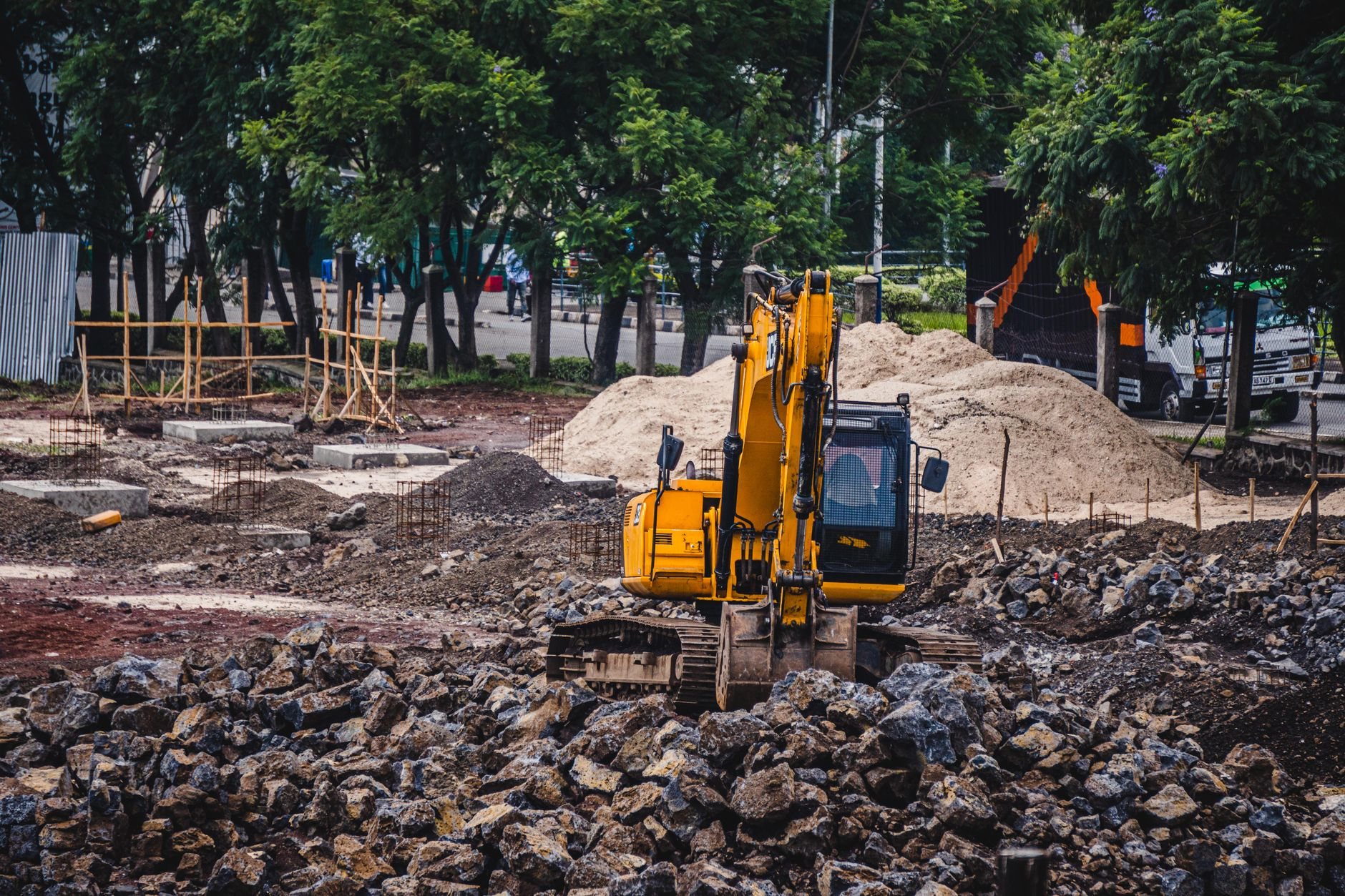
- Plan the access. Dense stone weighs roughly 150 to 170 pounds per cubic foot. A boulder three feet across is usually 1.5 to 2 tons; a four-footer can pass 4 tons. That decides the machine: a mini excavator with a thumb, a skid steer with forks or a grapple, or a crane truck reaching over the house when the only route to the backyard is a 36-inch gate.
- Dig the seat. A boulder sitting on top of the ground looks dropped and behaves badly — the Wasatch Front’s hundred-plus freeze–thaw days a year will rock and tip it within a few winters. We excavate a seat that buries the bottom quarter to third of the stone, compact it, and on loose fill or the collapsible bench soils common across Utah County we bed it on crushed base so a two-ton point load doesn’t settle and lean.
- Set and orient. Widest face down, weathered face out, bedding planes running horizontal and in the same direction across the grouping so the stones look like one outcrop. On slopes we tip each boulder slightly into the hill. The machine sets it, a bar and shims fine-tune it.
- Finish around it. Backfill packed tight, finish grade, and any rock mulch or planting that meets the stone. Soil should rise to the boulder, never leave a trench where water pools.
The difference between placed and dropped
Anyone with a machine can put a boulder in a yard. The tell is six months later. Placed boulders sit low, lean naturally, and group in odd numbers with varied sizes, so the eye reads a geologic event rather than a delivery. Dropped boulders sit high on their narrowest face, line up like fence posts, and collect a ring of bare dirt where the soil settled away. The Utah Geological Survey documents why local outcrops look the way they do; we copy that.
Along a drainage path, we seat boulders so a summer cloudburst flows around them rather than undercutting the uphill side.
What does boulder placement cost in Utah County?
As ballpark planning numbers only: locally quarried landscape boulders delivered and set commonly run $250 to $600 per ton installed, with specimen moss rock and any job needing a crane running higher. A grouping of six to ten mid-size boulders usually lands in the low to mid thousands. What moves the number most is tonnage, haul distance, whether a machine can reach the spot or a crane has to, slope, and how much finished yard we have to protect and restore. A firm estimate follows a site walk and a trip to the stone yard.
Questions we actually get
How big a boulder can you get into a fenced backyard?
Through a standard 36-inch gate, a mini excavator or tracked skid steer handles stone up to about a ton. Wider side yards allow a larger machine and two- to three-ton boulders. Beyond that, a crane truck sets the stone over the house or fence — more cost, but no real size ceiling.
Do landscape boulders need a footing or base?
Not a footing, but they need a prepared seat. We bury the bottom quarter to third of each stone and compact underneath it. On fill or collapsible bench soils, we add a few inches of compacted crushed base so the boulder doesn’t settle and tilt. That seat is what separates a stone that holds for decades from one that rolls.
Can you move boulders that are already on my property?
Yes, and it’s often the best value. Boulders unearthed during excavation or left by a previous owner are free stone already on site. We reset and regroup them, and supplement with matching yard stone if the set needs more mass.
Do I need a permit to place boulders?
Freestanding accent boulders generally don’t require a permit. Boulders stacked to hold back grade are a retaining wall, and walls at roughly four feet and taller typically need engineering and a permit in most Utah cities. Placement near a property line, drainage easement, or public sidewalk can trigger review — verify with your city’s building department first.
Where this work fits
Boulder placement is one scope within our landscaping and hardscaping work, part of the site, structure and envelope family. Boulders used as risers belong with outdoor steps. Our license is verifiable at dopl.utah.gov.
Tell us what you’re working on
Send a photo of the spot and the gate, and we’ll give you a straight read on stone, machine, and budget. We reply within a couple of hours during business hours — a day at most.