
Curved Deck Builders in Utah County
A curved deck swaps one or more straight edges for a radius — a bowed front, a rounded corner, or a full arc that follows a patio, a bay window, or a view. Grandview designs and builds curved decks across Utah County under a B100 general contractor license, laminated rim, bent fascia, and radius railing included.
When a curved deck is the right choice
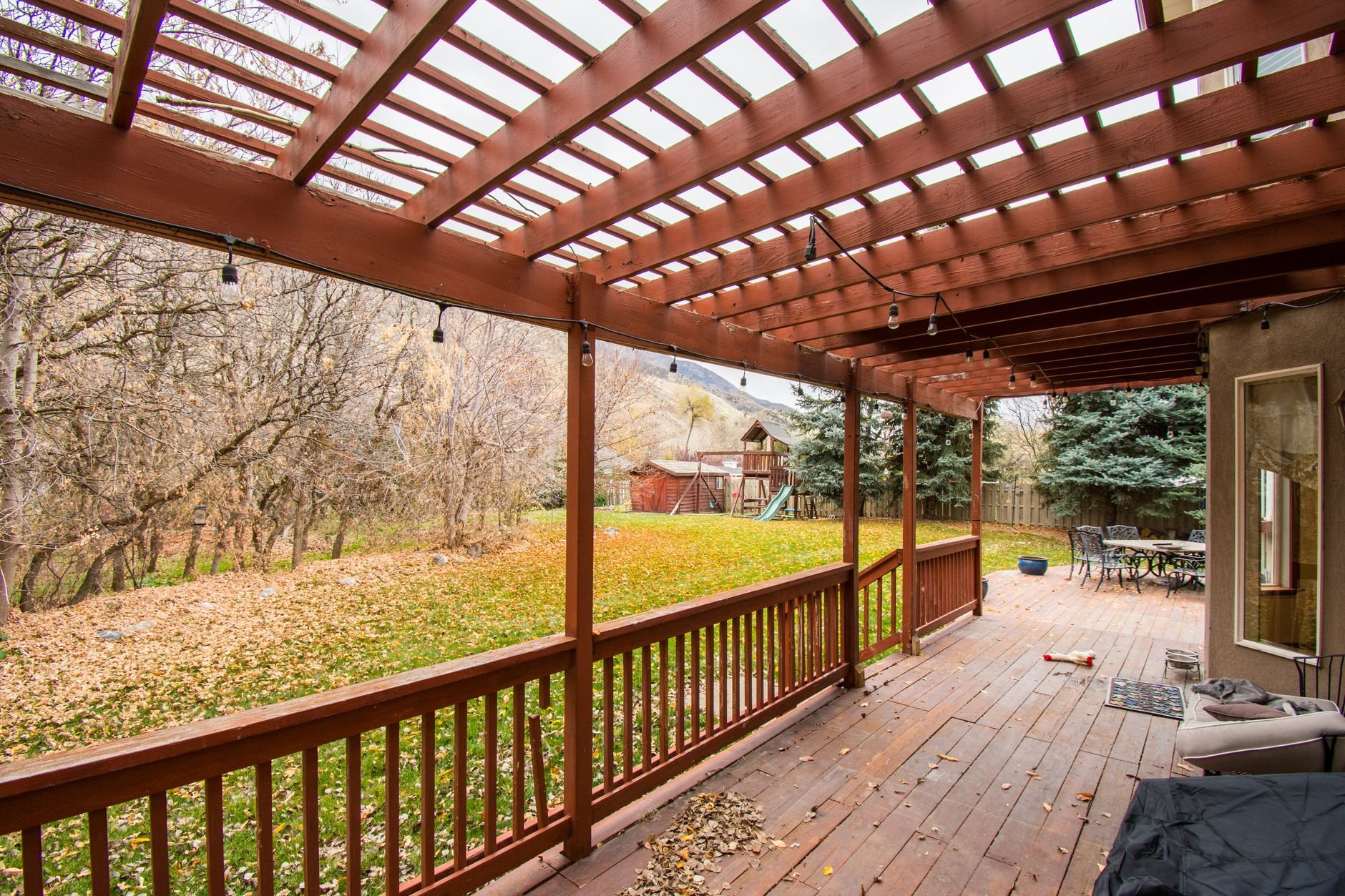
Curves earn their cost when the house or the site asks for one. A bay window or turret wants a deck that follows it instead of boxing it in. A round patio, fire pit ring, or pool below reads better when the deck edge echoes its shape. On a bench lot with a valley view, a bowed front rail puts more chairs at the edge of the view than a straight rail of the same length.
If what you actually want is more deck in more directions, a wraparound deck does that with square corners for less money. If you want zones at different heights, a multi-level deck solves it with steps rather than radii. If the only curved element is a rounded stair landing, that’s a stairs and railing detail, not a curved-deck project.
One honest caution: a curve is a design decision, not a structural upgrade. It costs more and takes longer, and it doesn’t make the deck stronger. We are fond of straight lines and straight answers; on this page, only the second one applies.
What building a curved deck involves
The curve lives in three places — frame, fascia, and decking — and each is built differently from a straight deck.
Framing the radius. The joists stay straight and parallel. What changes is the rim. We run the joists long past the curve line, swing the arc across them with a trammel from a fixed center point, and cut each joist end to the curve. A double or triple rim is then laminated around those ends from kerfed or thin pressure-treated stock, bent in place and fastened to every joist, with blocking along the arc to stiffen the cantilevered ends. Cantilever past the last beam is limited under current Utah-adopted code, so a deep bow usually means a curved beam line too — more posts and footings set on the radius instead of in a row.
Footings on an arc. Each footing bears below frost depth — commonly around 30 inches along the Wasatch Front, verified with your city — and on a curve the layout is unforgiving: a footing six inches off the arc puts its post outside the rim, so we lay out from the same center point as the rim.
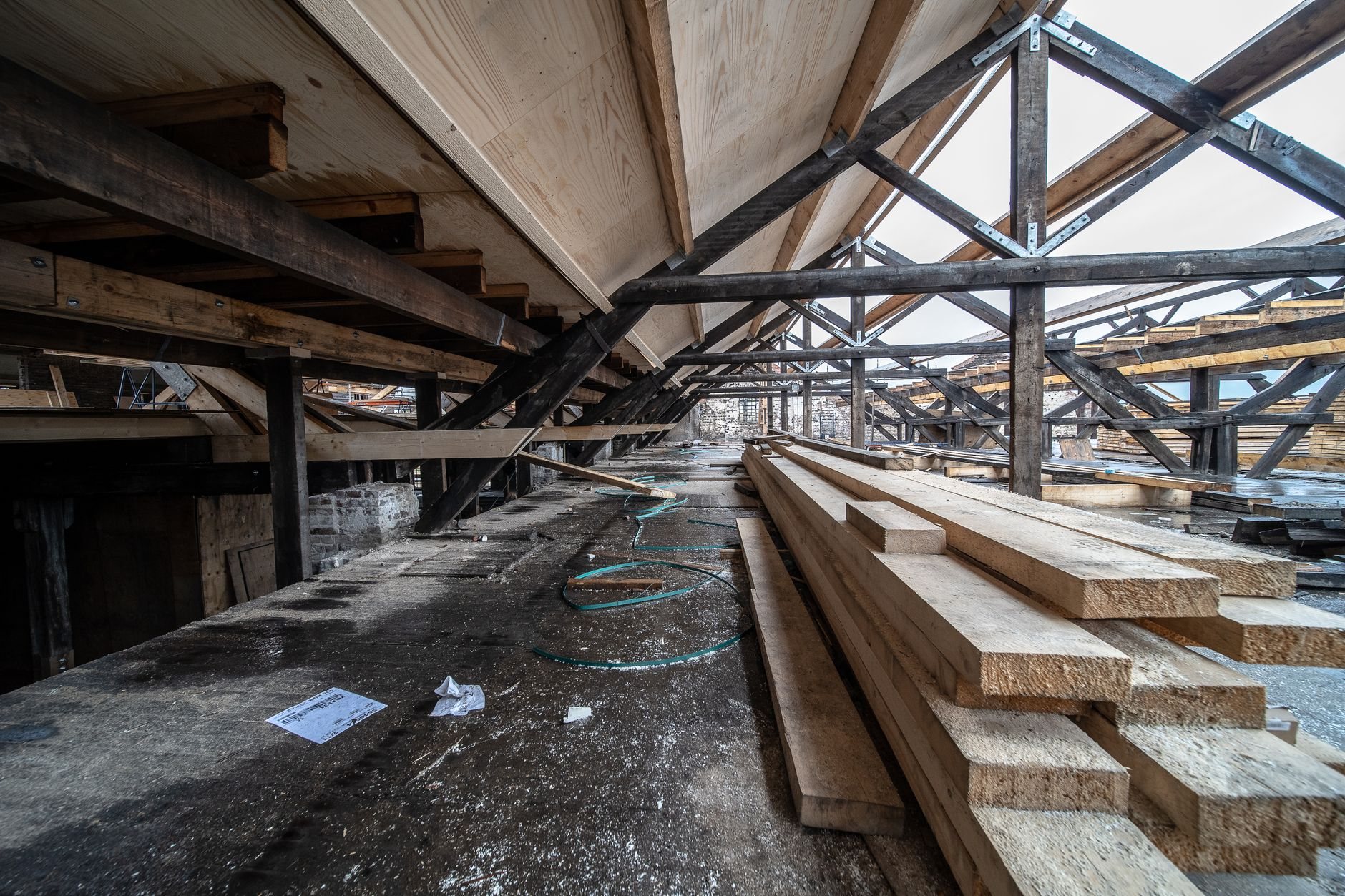
Fascia and decking. The exposed curved edge is where a curved deck gets judged. Composite and PVC fascia wrap a gentle radius cold; tighter radii need heat bending, and manufacturers such as Trex publish the minimum radius and heating method for their boards. Wood fascia is kerfed or laminated. At our elevation, UV works hardest on exactly this kind of exposed, south-facing edge, which is why we steer curved fascia toward capped composite or cellular PVC rather than stained cedar. Field boards run toward the curve, get cut to the arc, and finish under a heat-bent picture-frame border that hides the end cuts.
Which decking materials can actually bend?
Cellular PVC bends best — heated in a blanket oven it takes radii down to a few feet and holds the shape once cool. Capped composite from the major lines can be heat-bent to larger radii, with the manufacturer’s specification setting the limit. Pressure-treated and cedar boards don’t bend in service; curves in wood are cut, kerfed, or laminated. Ipe and aluminum decking don’t bend at all.
Our composite deck and PVC deck pages go deeper on each; the radius you want decides which stays on the list.
Railing on a curve
There are three honest ways to rail a curve. Segmented straight sections between closely spaced posts are the economical route; faceted up close, fine from the yard. Shop-rolled steel or aluminum rails bent to your radius are the clean answer, priced per linear foot. Cable rail runs straight between posts, so it needs posts every three to four feet to approximate the arc; glass panels are flat and must be segmented.
A curved guard meets the same code as a straight one: 36 inches minimum height, no opening that passes a 4-inch sphere. What changes is the post connection — posts fasten to a laminated, bent rim rather than a solid one, and on a bench lot exposed to canyon-wind gusts we tie those connections as a unit, not with a catalog bracket alone.
What does a curved deck cost in Utah County?
As a ballpark planning number — not a quote — plan on a 20 to 40 percent premium over a straight deck of the same footprint. Straight composite decks in our market run roughly $60–$95 per square foot installed, so a curved composite deck typically lands around $75–$130 per square foot with footings, framing, fascia, and standard railing. The job runs under a B100 license you can verify through Utah DOPL.
- Radius. Tighter curves mean heat-bent fascia, more laminations, and more footings per foot of edge.
- How much edge is curved. A single bowed front is the economical version; a full arc with curved stairs is the other end.
- HOA review. In the HOA-dense developments across northern Utah County, a curved design often needs a fuller drawing set than a rectangle.
After a site walk you’ll get a budget range, then a firm estimate once radius, material, and railing are settled.
Questions we actually get
Can you add a curve to an existing straight deck?
Sometimes. If the joists are sound and long enough, or can be sistered, we cut a new arc, laminate a new rim, and add footings on the curve; field boards get replaced because they need re-cutting to the arc. If the frame is near the end of its life, a deck repair assessment comes first.
How tight a radius can you build?
The frame can go tight — a few feet. The limit is the materials on the outside: PVC fascia and decking heat-bend to roughly a three- to four-foot radius depending on the line, composite needs a larger one, and rolled metal rail has shop minimums. We design the radius around the material you pick, not the other way around.
Does a curved deck need an engineer?
Often not for a gentle bow within cantilever limits. A curved beam line with a cantilevered rim, a hot tub on the curve, or a bench-lot snow load above the valley-floor standard can call for engineered framing, and some cities ask for it. We’ll tell you after the site walk and before the permit goes in.
Does the curve add time to the build?
Yes — plan on roughly an extra week on site for layout, laminating the rim, and heat-bending fascia and borders. The bigger schedule item is railing: shop-rolled rail can take several weeks to arrive, so we order it before footings are poured, not after the frame is up.
Tell us where you want the curve
We reply within a couple of hours during business hours — a day at most, with a straight read on radius, materials, footings, and budget. Curved decks are one branch of our custom deck construction work in the site, structure & envelope family.