
Pedestrian Gates in Utah County
A pedestrian gate is the walk-through gate in a fence line — the side-yard, front-path, or service gate you open by hand every day. Grandview builds and hangs them in wood, vinyl, aluminum, and welded steel across Utah County and Salt Lake County under a B100 general contractor license, framed so they swing true and latch cleanly for years.
When a pedestrian gate is the right choice
A pedestrian gate moves people, not vehicles. It’s typically 36 to 48 inches wide, hung on two posts, and opened by hand a few thousand times a year. If a car, trailer, or skid steer has to pass, you need a driveway gate, posted and hinged for a different load. If you want it opening on a keypad or fob, that’s an automatic gate and operator project.
A walk gate into a pool area is a barrier gate with its own rules for self-closing hinges, latch height, and swing direction; see the pool safety fence page. Most walk gates go in with a new fence installation; plenty are replacements for a gate that has sagged into the dirt on an otherwise sound wood privacy fence.
What keeps a walk gate swinging true
A fence panel sits still; a gate hangs its full weight off one post and gets pushed, pulled, and occasionally kicked. Four details decide whether it lasts.
Gate posts. Hinge and latch posts are heavier than line posts and set deeper in concrete — a 6×6 for wood, a heavier-wall steel post for metal fence. Along the Wasatch Front, expansive clay heaves shallow posts a little more each freeze–thaw cycle, and a hinge post that moves a quarter inch at the top puts the latch out of reach. We set gate posts below frost depth, generally 30 inches or more.
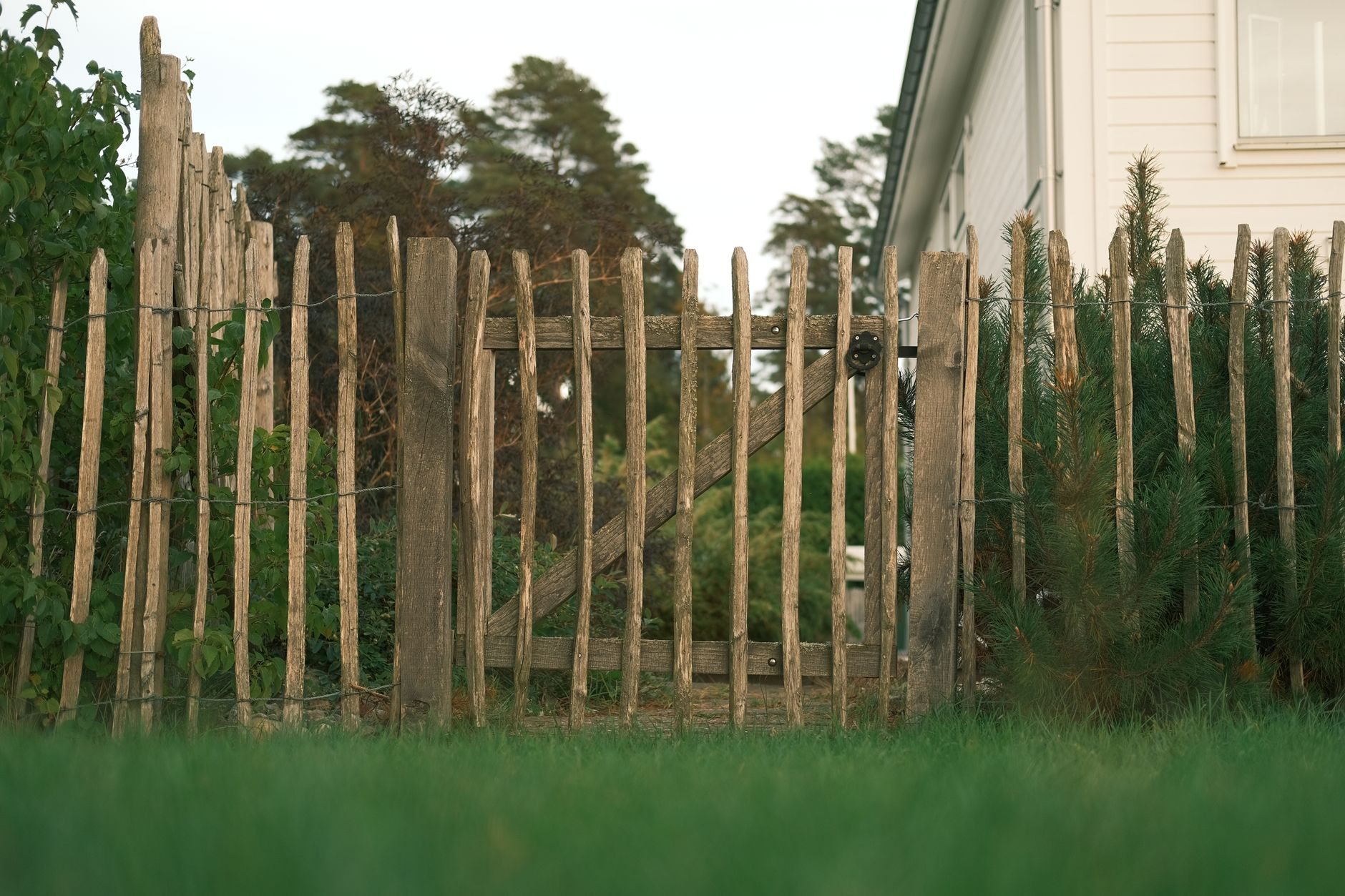
A rigid frame. A wood gate gets a diagonal brace from the bottom hinge corner up to the top latch corner so it works in compression — reversed, it does nothing, which is why so many homeowner-built gates drag within a season. Wood gates past four feet wide get a steel frame under the infill; vinyl gates carry a metal insert. Aluminum ornamental gates arrive as framed panels, and steel and wrought iron gates are welded to the design.

Hinges and latch. Hinges are rated for the gate’s real weight and left adjustable, so seasonal movement is a wrench job, not a rebuild. Latches match the use: a two-sided thumb latch for a front walk, a lockable gravity latch for a side yard, a keyed lever where security matters. On commercial and multifamily sites, gates on an accessible route need a 32-inch minimum clear opening and hardware usable without tight grasping, per the ADA Standards.
Swing and clearance. The gate swings into the property, clears the ground by two to three inches for snow and uneven grade, and stops on a gate stop rather than the latch post. Sloped side yards on bench lots mean the gate swings toward the uphill side or gets a bottom rail cut to the grade. On the east bench and in the north county, canyon gusts slam an unsecured gate hard enough to loosen hinges; a spring closer or a hold-open stop keeps it from becoming a sail.
How we build a pedestrian gate
- Site and swing. We confirm the opening, which way it swings, what has to pass through, and how the grade runs on both sides.
- Design and approvals. The gate matches its fence; in HOA-governed neighborhoods across Lehi, Saratoga Springs, and Eagle Mountain, gate style and hardware go into the same submittal.
- Posts first. Hinge and latch posts go in concrete below frost depth, plumb, spaced to gate width plus hardware clearance, and cure before anything hangs.
- Build or fit the gate. Frame, brace, and infill are assembled to match the fence. Utah’s elevation UV breaks down unsealed wood fast, so wood gates are sealed on all six sides first.
- Hang, adjust, walk it. Hinges on, latch aligned, stop and closer set, then we walk it with you.

What does a pedestrian gate cost in Utah County?
As ballpark planning numbers, not quotes: a standard 36-to-48-inch wood or vinyl walk gate built with a new fence typically adds roughly $350–$900. Aluminum ornamental gates run roughly $600–$1,500 installed. Custom welded steel gates start around $1,200 and climb with the design.
What moves the number: width (past four feet means a steel frame), material, hardware grade and locking, whether existing posts are reusable, slope at the opening, and custom fabrication. You get a budget range after a site look and a firm estimate once design and hardware are settled.
Questions we actually get
Why does my gate sag and drag on the ground?
Almost always one of two things: the hinge post has moved, or the gate was never framed to stay square. Posts shift when set too shallow for Utah’s frost depth and clay soils; gates rack when the diagonal brace is missing or runs the wrong way. We check both before quoting; a new gate on a leaning post sags again by spring.
Can you replace just the gate on my existing fence?
Yes, if the posts on either side are plumb and solid. We build a gate to match the fence and hang it on adjustable hinges. If the hinge post has heaved or rotted at grade, we reset it first — otherwise you’re paying for a gate that can’t stay aligned.
How wide should a pedestrian gate be?
Thirty-six inches clear covers people, strollers, and a wheelbarrow. Go to 42 or 48 inches if a riding mower, hot-tub delivery, or construction access will ever pass through. Commercial accessible routes need at least 32 inches clear. Past four feet, we frame the gate in steel to stop sag.
Does adding a gate change the fence quote much?
Modestly for a standard wood or vinyl walk gate — a few hundred dollars for the gate, heavier posts, and hardware. Custom steel, keyed or electrified locks, self-closing hardware, and sloped openings push it higher. One gate added to an existing fence costs more per gate, since the posts usually need resetting too.
Tell us what you’re working on
Send a photo of the opening and what needs to fit through it. We reply within a couple of hours during business hours — a day at most — with a straight read on scope, sequence, and budget. Gates are one piece of our site, structure & envelope work; the license behind them is verifiable at dopl.utah.gov.