
Stenciled Concrete in Utah
Stenciled concrete lays a disposable paper or adhesive stencil over fresh concrete or a thin overlay, then applies color hardener or a textured topping across it, so the pattern shows as colored “stones” with the base concrete reading as grout lines. It’s the flatter, lower-cost route to a brick, cobble, or tile look on patios and driveways, and Grandview installs it under a Utah B100 general contractor license.
Discuss a project Or call (385) 236-1741
When a stencil beats a stamp, and when it doesn’t
Stamped concrete presses a pattern into the full slab, with real relief and grout-line shadows. A stencil leaves the slab essentially flat: the pattern comes from color contrast, and texture is a light skin rolled over the top. That makes stenciling the better call for driveways and walks you’ll shovel all winter, and for owners who want brick or cobble without the stamped price.
It also works over existing concrete: a sound slab takes a thin topping sprayed through an adhesive stencil, a smaller job than full concrete resurfacing.
Choose something else in three cases. If it must pass for natural flagstone up close, stamp it; a stencil repeats on a fixed module. If the slab only needs color, staining costs less. And if you want pattern cut into cured concrete rather than laid on it, engraving scores the lines permanently, with nothing to peel.
How a stenciled surface is built on fresh concrete
The stencil is a roll of heavy, water-resistant paper die-cut in a running-bond brick, cobblestone, ashlar tile, herringbone, or basketweave module. It goes down in a narrow window: after the bleed water is gone and the surface holds a thumbprint, but before it stiffens enough to tear the paper on removal.
- Layout on paper first. Modules don’t stretch, so we plan where the pattern starts and land control joints on grout lines.
- Base, forms, and pour. Compacted gravel over a base checked for the expansive clay common on Utah County lots, rebar or fiber, and an air-entrained mix. A stencil adds no strength; patios pour at four inches, driveways at five to six.
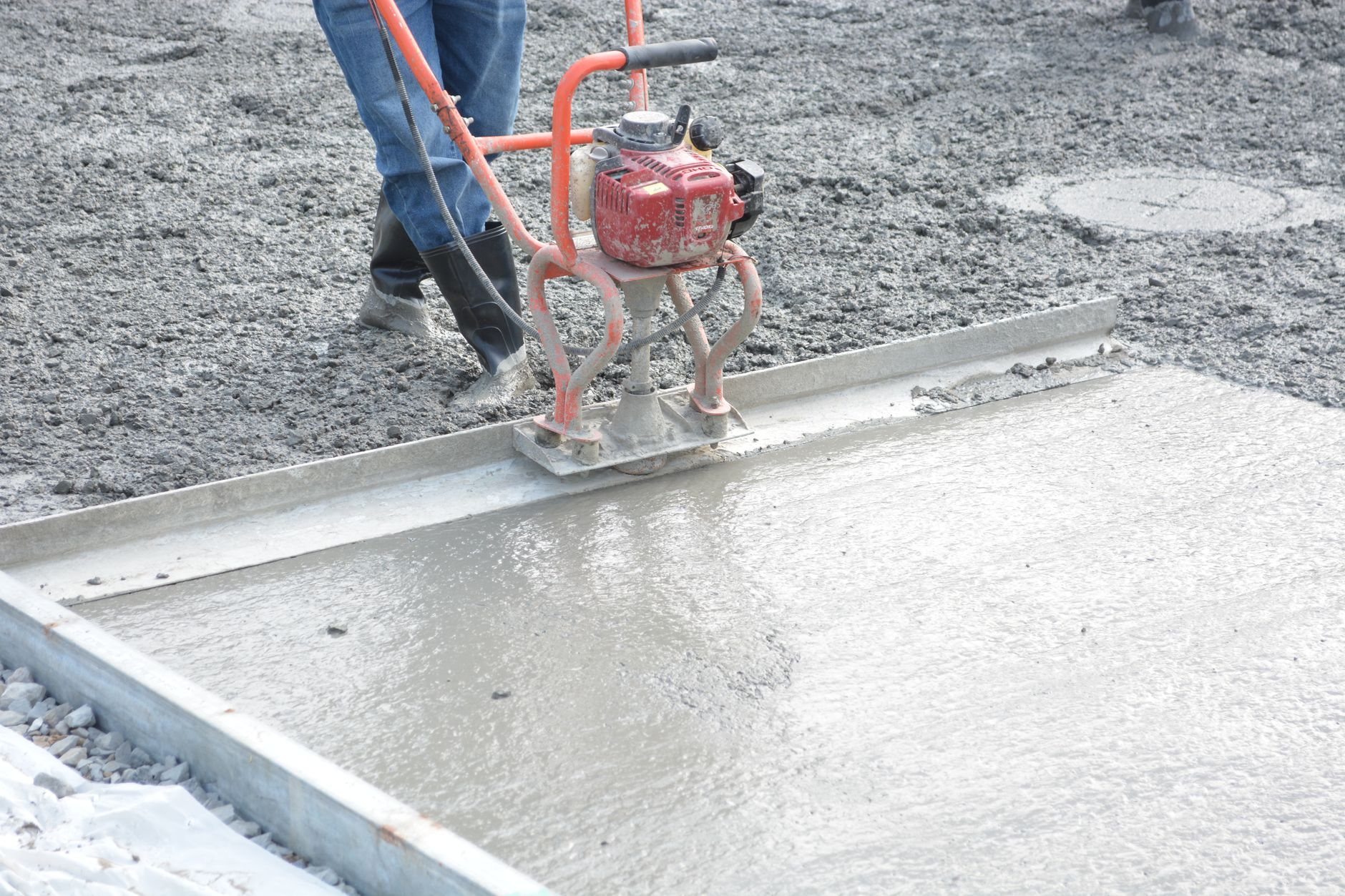
- Screed and float. Bull-floated flat and open, no troweled sheen, so the stencil can grip.
- Stencil down. Sheets overlap at the registration marks so courses line up across seams, then get pressed in with a stencil roller. Loose edges now are blurred grout lines later.
- Color hardener broadcast and floated. Two dry-shake passes over the stencil. The paper masks the grout lines, which stay gray, while the stones take the hardener color.
- Texture, then lift. A slate texture skin rolls across, then the stencil is pulled while the concrete is still plastic, taking the overspray with it. On a July afternoon along the Wasatch Front the surface can close in forty minutes, so summer stencil pours start at first light.
- Cure, cut, seal. Joints sawn on grout lines the next day; after cure, an acrylic sealer with anti-slip grit holds the color against high-elevation UV.
Stenciling an existing slab
Over sound existing concrete the stencil is adhesive-backed and the “stone” layer is a cement-polymer topping, sprayed as a knockdown texture over a primed, profiled slab, with the base slab or a tinted base coat showing through as grout lines. Depth is an eighth to a quarter inch, so floor height barely changes at thresholds. The honest limit: the topping inherits every crack and all the moisture beneath it, and freeze and thaw will lift it at the edges of a slab that heaves or holds water. We’ll tell you to repair first.
What does stenciled concrete cost in Utah?
As a ballpark planning number, not a quote, stenciled concrete on a new pour along the Wasatch Front typically runs about $11 to $17 per square foot installed. A stenciled overlay on an existing sound slab usually lands around $8 to $14. Both sit below stamped and above a plain broom finish.
- Pattern module. Running-bond brick goes down fast; small cobble and herringbone mean more seams to register while the surface is closing.
- Grout-line color. Gray lines are free. Integrally colored joints pigment the whole load even though only the lines show it.
- Borders and medallions. A contrasting border is a second layout and second color on the same pour day.
- Slab condition, on overlays. Crack repair, grinding, and moisture testing come before any topping and are the swing items.
- Season. A stencil pour wants a cool, calm morning; shoulder-season dates are easier on the finish and the price.
A conversation, a budget range after a site walk, then a written proposal. The proposal is the number.
Questions we actually get
Does stenciled concrete look fake?
Close up it looks like a patterned slab, not laid brick, because the surface is flat and the module repeats. From the sidewalk it reads as brick or cobble, helped by a texture skin and contrasting grout lines. If the standard is “nobody can tell,” stamped concrete or pavers are the honest answer.
Will the stencil pattern peel or wear off?
On a fresh pour, no. The color hardener is part of the concrete surface; only the sealer wears, so resealing every two to three years keeps it. On an overlay, bond is only as good as the prep and the slab’s moisture condition, which is why we test before committing.
Can a stenciled driveway handle Utah winters and snow shoveling?
Better than most decorative finishes. The surface is flat, so shovel and plow blades slide over it instead of catching in grout lines. The concrete still needs an air-entrained mix to survive our hundred-plus freeze and thaw days, and the sealer still hates deicing salt. Sand the first winter.
Can you stencil over my existing patio or garage floor?
If the slab is sound, drains, and passes a moisture test, yes, with an adhesive stencil and a thin cement-polymer topping. Slabs with offset cracks, heaving, or standing water aren’t candidates; the topping would follow their problems. We inspect first.
Stenciling is one finish within our decorative and stamped concrete work, part of the site, structure and envelope family. It often shares a pour schedule with new driveways and flatwork, all under Grandview’s Utah DOPL B100 license, verifiable at dopl.utah.gov.
Tell us what you’re working on
Send a photo of the slab and rough dimensions. We reply within a couple of hours during business hours, a day at most, with a straight read on stencil versus stamp, sequence, and budget before anyone commits to anything.