
Ornamental & wrought iron railings in Utah County
Ornamental wrought iron railings are solid-bar picket rails built with scrolls, twists, collars, and cast accents — the traditional look for porches, balconies, and stairs on older homes, or on new ones that want that character. Grandview fabricates, installs, repairs, and matches wrought iron style railings across Utah County and Salt Lake County under a Utah DOPL B100 license.

When a wrought iron railing is the right choice
One honest note first. Almost nothing sold as wrought iron today is wrought iron — the mills stopped rolling it decades ago. What we build is ornamental railing in solid mild-steel bar, forged and bent the way iron was. The term stuck; the craft is the same.
Pick it when the house asks for it. A 1910s brick bungalow in Provo’s Joaquin neighborhood or a Sugar House four-square looks wrong with a square-tube rail; a scrolled porch rail is often what makes a restoration read as finished. Pick it for a curved stair, where solid bar bends into a helix more gracefully than tube.
It isn’t the right call everywhere. A modern deck is usually better served by a plain fabricated steel guardrail or a cable railing that keeps the view. Where weight is a problem — a cantilevered balcony on light framing — aluminum railings come in ornamental patterns at a third of the mass. And a plain graspable stair rail is a metal handrail job, not an ornamental one. Code heights that apply to every material live on our metal railings and handrails page.
What ornamental iron fabrication involves
Stock. Pickets are ½- or ⅝-inch solid square bar, not hollow tube — solid bar is what lets a picket be twisted, hammered, or bellied without collapsing, and why an iron rail weighs two to three times a tube rail. Rails are channel or flat bar; posts are 1½- to 2-inch solid or heavy-wall square.
Ornament. Scrolls — C-scrolls, S-scrolls, and the fishtail-ended versions — are cold-bent on jigs so every scroll on a run matches, then forged where a tighter eye or hammered texture is wanted. Twisted pickets are the same bar, heated and turned. Baskets, collars, rosettes, and finials are cast components we source and weld in. Patterns are drawn to your actual run, so a scroll pair lands centered between posts rather than cut off at the end.
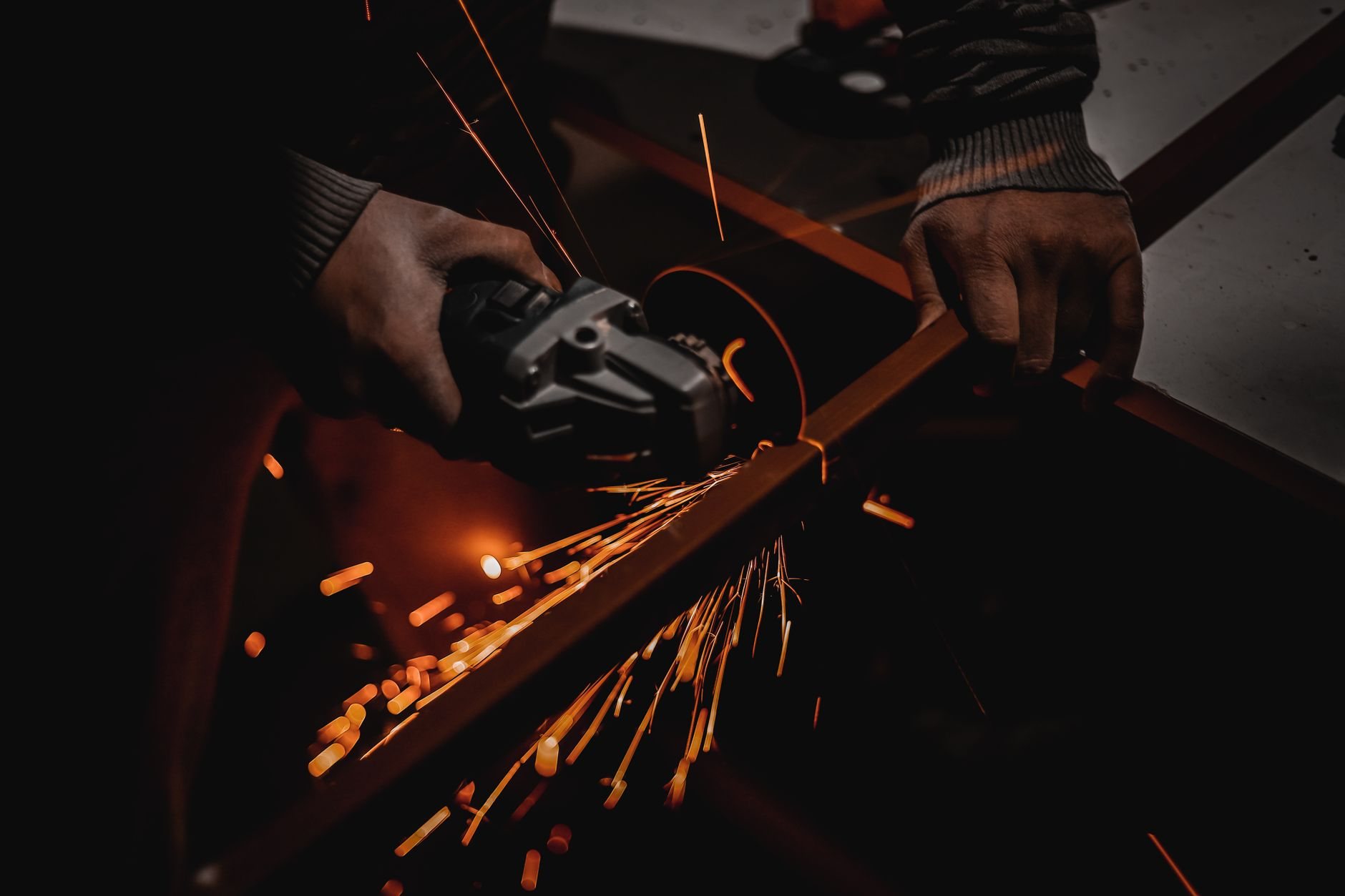
Welding and cleanup. Every picket is welded top and bottom and every weld ground back so the rail reads as one piece of iron. Picket spacing holds under 4 inches clear per current Utah-adopted code, including the gap inside a scroll pair — a detail period patterns routinely fail, so we adjust the spacing, not the look.
Finish and anchoring for Wasatch Front exposure
Exterior iron fails by rusting at the picket bases, where water sits on the bottom rail. A Wasatch Front railing goes through roughly a hundred freeze-thaw days a year plus a winter of sidewalk salt, so exterior ornamental rails get a duplex finish: hot-dip galvanizing, then powder coat over it. Galvanizing reaches inside every joint paint can’t; the powder coat gives you the color. We specify satin or textured black over flat, because high-elevation UV chalks flat black to gray within a few seasons.
Anchoring is where older homes get interesting. Early-1900s porch rails were set in lead or sulfur poured into pockets in sandstone or concrete steps. Those pockets spall as they freeze, and rails rock in them by spring. We core out the old pocket, set the new post in epoxy sized for the pull-out load, and slope the fill to shed water. If the step itself can’t hold a post, we say so before we bolt to it.
What do wrought iron railings cost in Utah?
As ballpark planning numbers only: a straight-run ornamental iron railing with a standard picket-and-scroll pattern, galvanized and powder coated, typically installs for about $175–$350 per linear foot in Utah. Hand-forged work — heavy scrollwork, baskets and twists on every picket, cast finials, or a matched historic section — commonly runs $350–$700 per foot and up. The proposal after a site visit is the real number.
Ornament is the first lever, and it scales by the piece: each scroll, twist, and collar is handled individually, so a scroll pair in every bay costs far more than one at each end. Duplex finishing adds a galvanizing trip and a week or two of lead time but removes repainting from your life. Matching an existing rail costs more than building new. Anchoring into deteriorated stone or old concrete is slower than a sound slab.
Questions we actually get
Can you match the original iron railing on my older home?
Usually, closely enough that the new section disappears. We measure picket size and spacing, trace the scroll profile, and match finish sheen. Hand-forged texture can be replicated at a higher cost. The one thing we won’t match is a rail height or picket gap that fails current code — a replaced or extended section generally has to come up to it.
Do I need historic approval to replace a porch railing?
Sometimes. In Salt Lake City’s local historic districts, exterior changes visible from the street generally go through the city’s historic preservation review. A like-for-like iron replacement is usually the easiest case to approve. We confirm with your city’s planning office and fold that step into the schedule.
Will an iron railing rust in Utah?
Painted-only iron outdoors will, starting at the picket bases, usually within a few winters of salt and freeze-thaw. Galvanized and powder-coated iron essentially doesn’t; the zinc protects the steel even where the coating chips. That duplex finish is our default for anything exterior.
Can you repair a loose or rusted iron rail instead of replacing it?
Often, yes. Rocking posts are usually a failed pocket, not a failed rail — we re-core and re-set them in epoxy. Rusted bottom rails and picket feet can be cut out, new bar welded in, and the rail refinished. Past about a third of the rail, a matched replacement is normally cheaper than piecework.
Tell us about the railing you have in mind
Send a photo of the porch, stair, or balcony, or the pattern you want to match. We reply within a couple of hours during business hours — a day at most — with a straight read on pattern, finish, and budget range. Matching iron gates are covered under custom steel gates and fences; the rest of our fabrication lives on the specialty capabilities hub. Licensed and insured; verify our B100 at dopl.utah.gov.