
Stock cabinet installation in Utah County
Stock cabinets are factory boxes in fixed sizes and finishes, warehoused and shipped in days instead of months. Grandview Contractors supplies and installs them across Utah County and Salt Lake County under a B100 general contractor license — set level, scribed tight, and anchored to framing, the same way we set cabinets that cost three times as much.
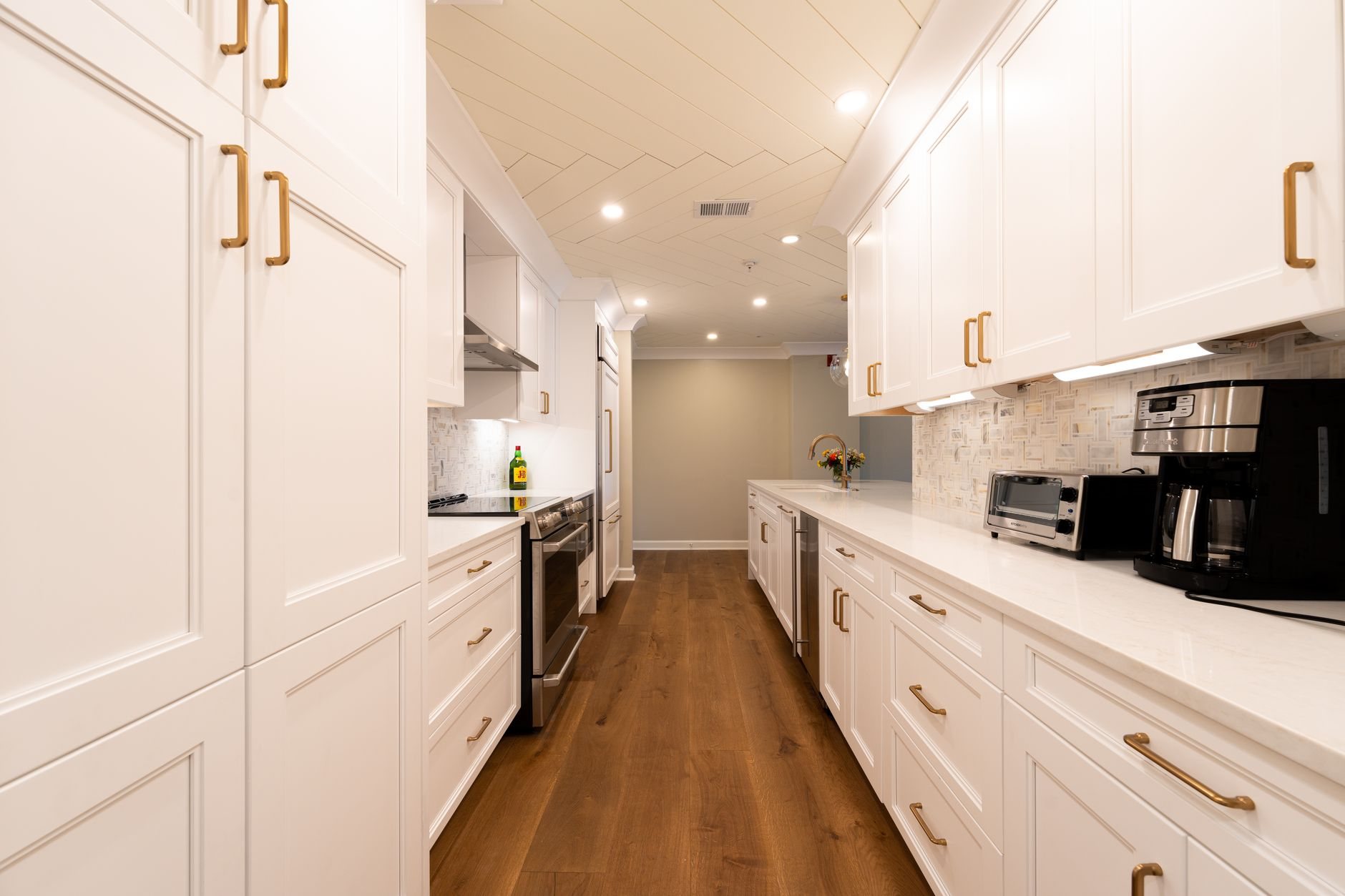
Stock is the right call when the layout works and the clock matters
Stock cabinets make sense in four situations. You’re keeping the footprint, so a 3-inch sizing grid can be made to fit. You need the kitchen back fast — a rental turnover, a flip, a listing, a family that can’t lose the sink for six weeks. The budget has a hard ceiling. Or the room is secondary: a basement kitchenette, a laundry room, a garage wall. It’s the entry tier of our cabinetry and countertop work.
They’re the wrong call when the walls are badly out of square, the ceiling is unusually tall, or you need a door color or a 27-inch-deep base the line doesn’t carry. That’s when semi-custom cabinets earn their premium with modified depths and widths, and when custom cabinetry earns its lead time. If your current boxes are sound and you only dislike their face, cabinet refacing is usually cheaper than even stock replacement. We’ll say which your room needs at the walkthrough.
Fixed sizes, fillers, and a few upgrades worth paying for
Stock lines come in widths from 9 to 48 inches in 3-inch steps, one base depth (24 inches), one upper depth (12 inches), and upper heights of 30, 36, or 42 inches. Nothing in between. Fitting a real room to that grid is the whole craft of a stock install: gaps close with filler strips at the walls, blind-corner or lazy-susan units at inside corners, and panels on exposed ends. A good layout hides fillers beside the dishwasher. A bad one leaves a 4-inch painted strip next to the range.
Most entry lines use a ⅝-inch furniture-board box with a hardboard back and cam-and-dowel joinery if they ship flat-packed (RTA). The upgrades we recommend, in order: a plywood-box option where the line offers one, because a furniture-board sink base that meets a leaking supply line swells and never recovers; soft-close hinges and glides; full-depth drawer boxes. Skip the rest. Certification under the KCMA ANSI/KCMA A161.1 standard is worth finding on the spec sheet — it tests door-slam cycles, shelf loading, and finish resistance to household liquids.
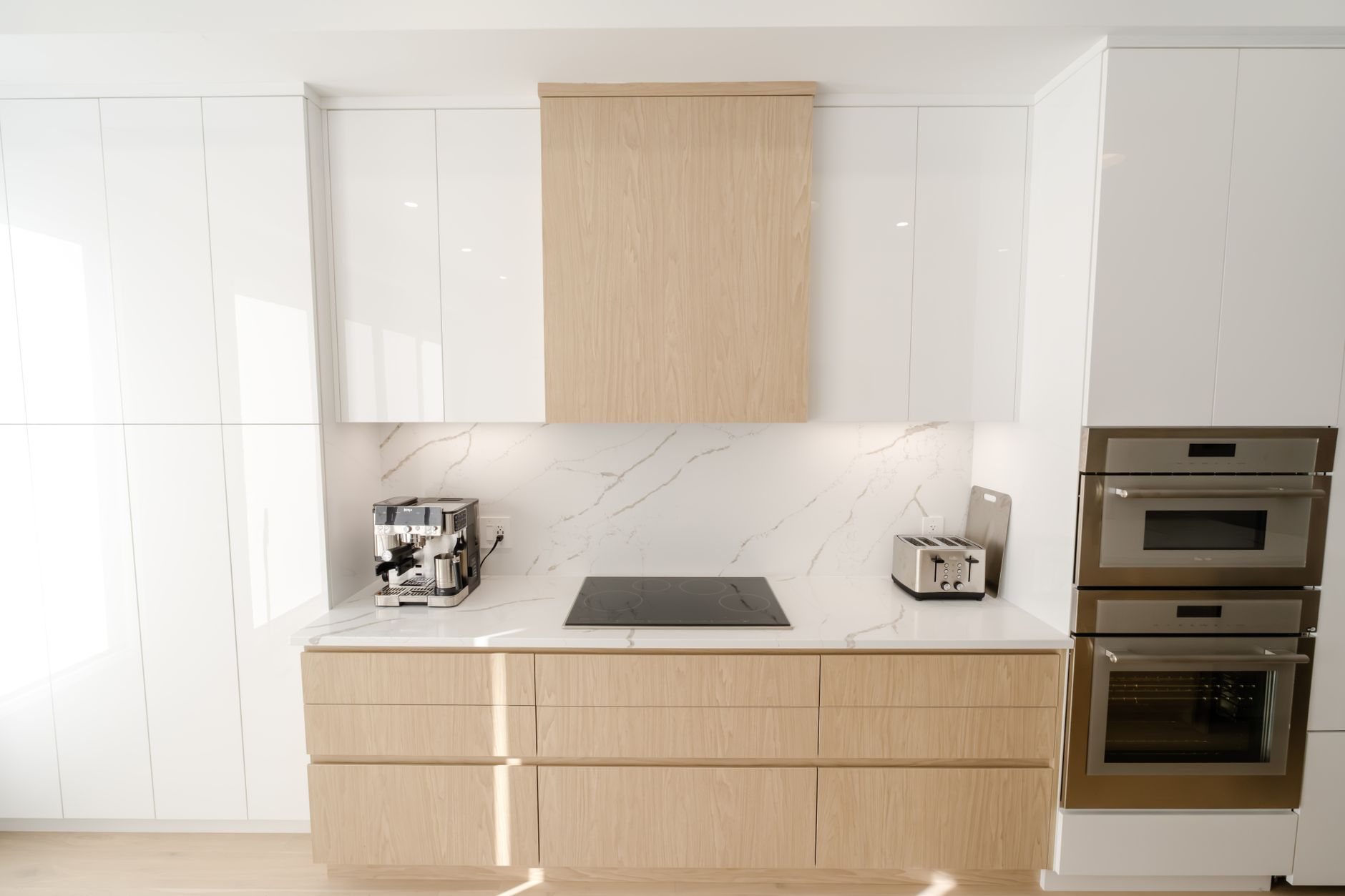
The order of a stock cabinet install
- Measure to the grid. We lay the room out in 3-inch increments before ordering, locating fillers and corner units and checking appliance openings — a 30-inch range needs a 30-inch gap, not a 31-inch one.
- Find the high point. Floors in older Provo and Orem homes routinely fall an inch across a kitchen. We strike a level line at 34½ inches off the high spot and shim every base up to it. Counters sit on that line, not on the floor.
- Uppers first, off a ledger. A temporary ledger holds the uppers at height while we clamp the face frames flush and drive washer-head screws into studs through the hanging rail. Along the Wasatch fault, uppers loaded with dishes get fastened to framing, never to drywall alone.
- Bases, fillers, panels. Bases get set to the level line, screwed to each other and to the wall. Fillers are scribed to the wall’s actual shape, not cut square. Toe kicks and end panels go on last.
- Counters and connections. Post-form laminate can go on the same week; quartz needs a template off the set boxes and one to two weeks of fabrication. Licensed plumbers we coordinate reconnect the sink, faucet, and dishwasher — in our hard-water area, that’s the moment to add a filter line if you want one. The full-room sequence with islands and appliances is covered under kitchen cabinet installation.
What does stock cabinet installation cost in Utah?
As ballpark planning numbers, stock boxes for a typical Utah kitchen land in the low hundreds of dollars per linear foot for material, with install labor roughly a third to half again on top; counters, hardware, demolition, and haul-away are separate. A 10-by-12 kitchen is usually a four-figure cabinet line item, not five.
What moves it up: plywood-box and soft-close upgrades, pre-assembled versus RTA, 42-inch uppers, corner and specialty units, end panels, and how many fillers an out-of-square room demands. What moves it down: keeping the footprint so no plumbing or electrical moves (a like-for-like swap generally needs no permit under current Utah-adopted code), reusing sound counters, and ordering a line the local distributor stocks rather than quick-ships. In the newer subdivisions of Lehi, Saratoga Springs, and Eagle Mountain, builder-grade stock lines are usually still in production, so adding a matching pantry wall or island without replacing everything is often possible. When the project grows into moving walls or plumbing, it becomes a kitchen remodel; everything else we renovate starts at renovation and build-outs. All of it is contracted under one B100 license, verifiable at dopl.utah.gov.
Questions we actually get
Can you install stock cabinets I bought myself from a big-box store?
Yes. We check the order against the room before install day — missing fillers, a wrong-hand corner unit, or a 33-inch sink base under a 36-inch sink are the usual problems, easier to fix before the old cabinets come out. We supply the cabinets when you’d rather have one invoice and one responsible party.
How long does a stock cabinet installation take?
In-stock lines ship in days, quick-ship lines in one to three weeks. On site, a typical kitchen takes one day to demo and two to three days to assemble and set. Laminate tops go on the same week; quartz or granite adds one to two weeks for templating and fabrication.
Will stock cabinets hold a quartz or granite countertop?
Generally, yes — 3 cm stone runs roughly 18 to 20 pounds per square foot, and a well-set stock base carries it when the boxes are level, screwed together, and anchored to the wall. The weak points are a wide furniture-board sink base and unsupported overhangs; we add a sub-top or corbels where the span needs it.
Do stock cabinets come in the color I want?
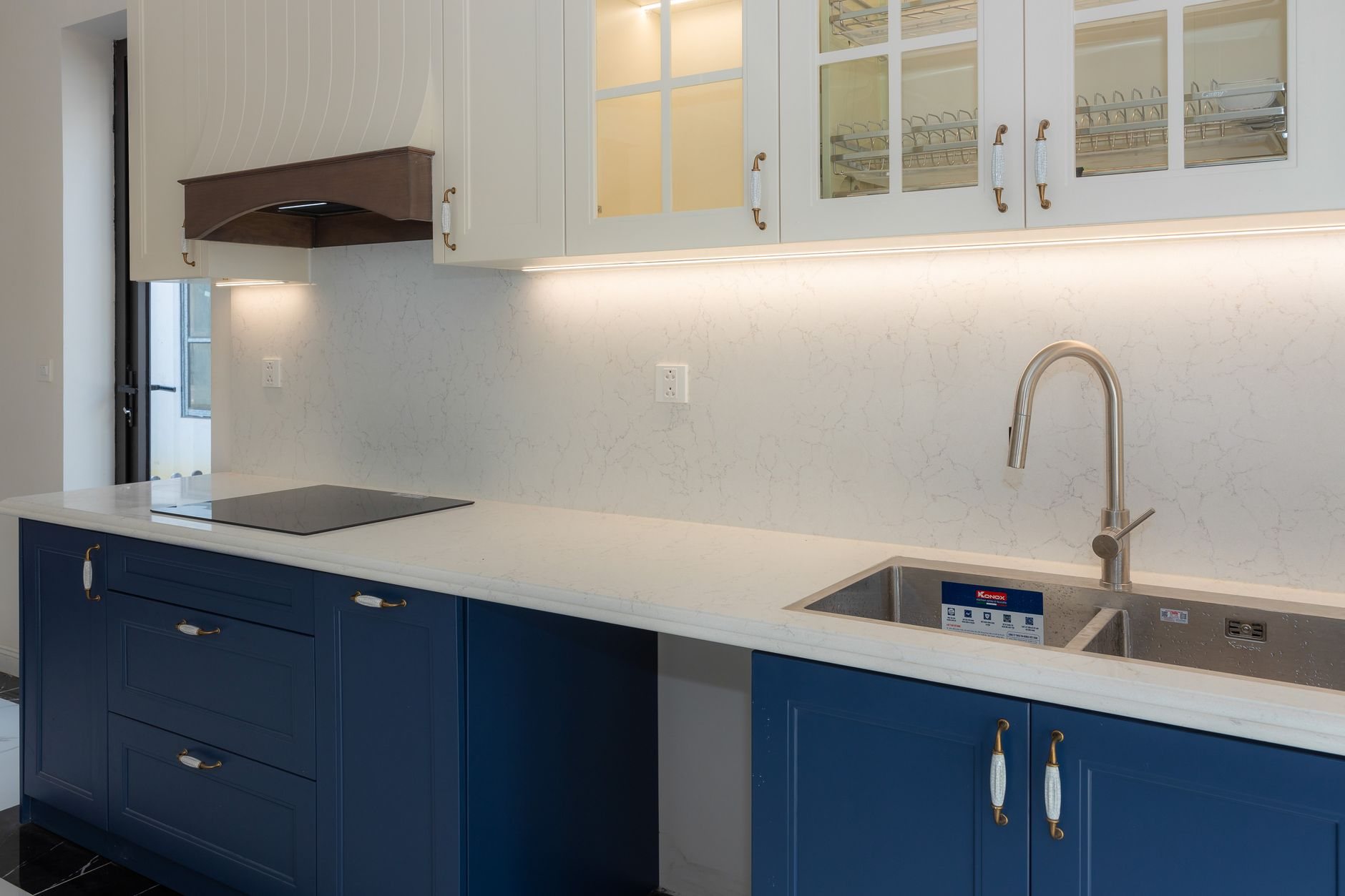
Each line carries a fixed menu — usually white, a gray or two, a few wood stains, lately navy or green. If your color isn’t on it, the options are a semi-custom line, a site-applied paint finish, or refacing with doors in your color. We’ll tell you which is cheapest for your room.
Tell us what you’re working on
We reply within a couple of hours during business hours — a day at most. You’ll get a straight read on scope, sequence, and budget before anyone commits to anything.